

This article is for general education and is not medical or nutrition advice for you personally. I am a physical therapist and certified lymphedema therapist, not a dietitian.
Before making any changes to how you eat, please seek guidance from a Registered Dietitian who is informed about the lipedema diagnosis.
One of the questions I hear most often in my clinic is, "What should I be eating?" I understand why it comes up. Many of my patients spent years being told their legs would change if they just tried harder with food, and they did try, again and again. By the time they reach me, food can carry a lot of worry.
So I want to start with what I tell every patient: lipedema is not your fault, and it is not caused by what you eat. Food is one way to care for your body while you live with a chronic condition. It is not a test you pass or fail.

Why Does Food Matter With Lipedema?
Lipedema tissue involves ongoing, low-grade inflammation, and many patients notice their legs feel heavier and more tender during inflamed periods. Food is one of several things that influence inflammation in the body.
The strongest evidence I can point to comes from research on Mediterranean-style eating in the general population. A meta-analysis of 17 randomized controlled trials with about 2,300 people found that this way of eating lowered two common blood markers of inflammation, C-reactive protein (CRP) and interleukin-6 (IL-6), compared with control diets(1).
Research on specific eating plans in lipedema itself is still early. A 2025 systematic review found only nine small studies, including 269 women. Most had a moderate to high risk of bias, and the authors concluded that the effects of dietary approaches on lipedema remain unclear. They also noted that almost none of the studies looked at eating behaviors or mental health(2). That gap matters to me, and it is a big part of why I send patients to a dietitian instead of handing them a plan.
Adding Foods That Support Your Body
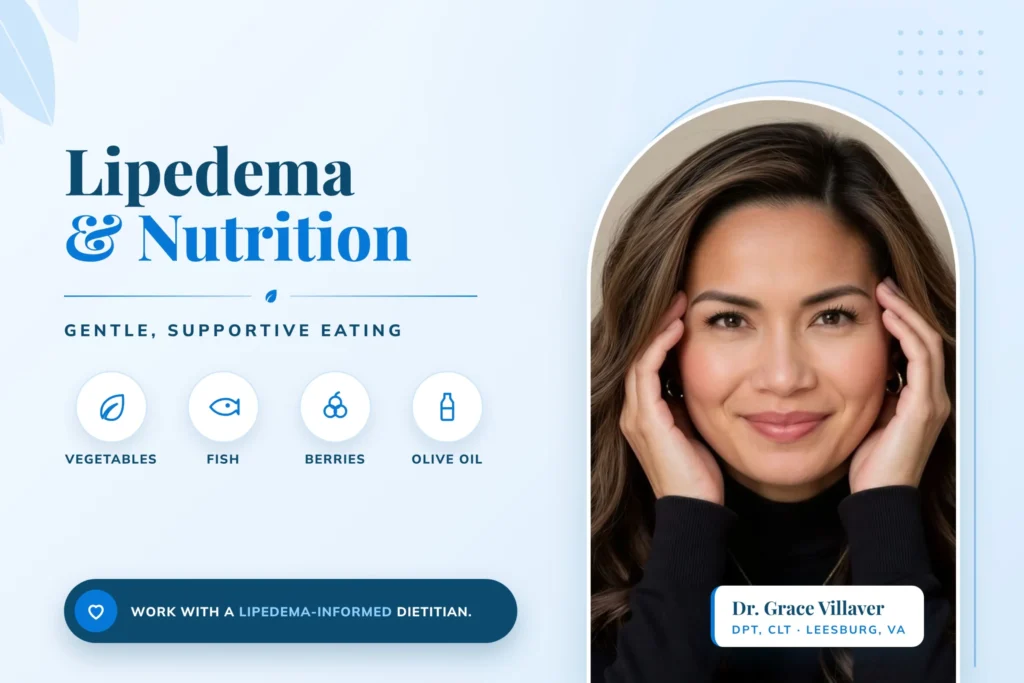
When we talk about food in my clinic, the focus is on what you can add to your plate, with variety and enjoyment, rather than on what to take away. These are the kinds of foods that make up Mediterranean-style eating patterns:
- Fish rich in omega-3s: salmon, sardines and mackerel, along with plant sources such as flaxseed, chia seeds and walnuts.
- Leafy greens and colorful vegetables: spinach, kale, broccoli, peppers, tomatoes and whatever is in season near you.
- Berries and other fruit: blueberries, strawberries, raspberries, citrus and apples.
- Olive oil, avocado, nuts and seeds: for cooking, dressings and snacks.
- Herbs and spices: turmeric, ginger, garlic, oregano and rosemary add flavor and color.
- Beans, lentils, eggs, poultry and fish: a mix of protein sources that keep meals satisfying.
- Whole grains: oats, quinoa, brown rice, barley and whole-grain bread.

There is no perfect plate. Some days will look like this list and some days will not, and that is part of ordinary life. A Registered Dietitian can help you fit these foods around your culture, budget, schedule and the meals you already enjoy.
Why I Do Not Recommend Cutting Out Foods on Your Own
Many women with lipedema have a long history of dieting before they ever hear the word lipedema. A 2025 review on the psychological side of lipedema described higher rates of anxiety, depression and eating disorders in people with the condition, often linked to years of misdiagnosis(3). In a small 2026 survey of 47 women with lipedema, about two in three screened positive for disordered eating risk(4). That was a screening survey, not a diagnosis, but it lines up with what many of my patients describe.
For that reason, I do not recommend removing foods or food groups on your own. If you suspect a food intolerance, or you have digestive symptoms that worry you, that is a question for your doctor and a dietitian, who can assess it safely and make sure you still get the nutrition your body needs.
Finding a Registered Dietitian Who Understands Lipedema
Not every nutrition professional is familiar with lipedema, so it is worth asking a few questions before you start. Look for a Registered Dietitian (RD or RDN) who has worked with lipedema or similar chronic conditions, who understands that lipedema is a distinct medical diagnosis, and who will build a plan with you around your health and how you feel. Your primary care doctor or lipedema physician can often recommend someone, and I am glad to talk this through with my patients as well.
When you meet with them, it helps to share what you have noticed about your symptoms, such as times of day your legs feel heavier, your energy, sleep and digestion. Your dietitian can decide with you whether keeping any notes would be useful, and how to do it in a way that feels supportive.

What My Patients Say
Food Is One Part of Your Care
Nutrition sits alongside the rest of lipedema care rather than replacing it. In my clinic, that care is built on Complete Decongestive Therapy (CDT): manual lymphatic drainage, compression, skin care and clinically guided exercise that supports your lymphatic system. When patients also have a dietitian on their team, each part of their care can support the others.
If you are in Leesburg, Loudoun County or Northern Virginia and would like help with the lymphatic and movement side of lipedema, my lipedema and lymphedema therapy sessions take place at my Leesburg clinic, and you can reach out here to start that conversation.
And for anything to do with what you eat, please work with a Registered Dietitian who is informed about the lipedema diagnosis.
References
- (1) Schwingshackl L, Hoffmann G. Mediterranean dietary pattern, inflammation and endothelial function: a systematic review and meta-analysis of intervention trials. Nutr Metab Cardiovasc Dis. 2014;24(9):929-939. doi:10.1016/j.numecd.2014.03.003
- (2) de Oliveira J, de Paula ACP, Guimarães VHD. Clinical or cultural? Dietary interventions for lipedema: a systematic review. Maturitas. 2025:108716. doi:10.1016/j.maturitas.2025.108716
- (3) Seynhaeve B, et al. Lipedema: The Psychological Dimension. Arch Psychiatry Psychother. 2025;2:59-66. doi:10.12740/APP/201427
- (4) Kunzová M. Disordered Eating Risk and Well-Being in Women with Lipedema. Front Glob Womens Health. 2026;7. doi:10.3389/fgwh.2026.1720708
