


I have had more conversations than I can count with lipedema patients who tell me the same thing: they tried to exercise, they pushed through the pain and fatigue, and they ended up feeling significantly worse. Some were told it was just deconditioning. Some were told to push harder. And some, understandably, gave up on movement altogether.
None of those outcomes were necessary. The problem was never the exercise itself. It was the dose.
Movement is one of the most powerful tools I use in lipedema management. But what makes it work, and what makes it backfire, comes down to a level of precision that most general exercise guidelines do not address. That is what I want to walk you through here.
What Is Actually Happening in Your Body
Think of your immune system as having an overly sensitive alarm system. Your body releases a chemical called histamine, and in the case of lipedema, especially when MCAS or inflammatory co-conditions are present, that alarm goes off too easily, too loudly, and for too long. This causes symptoms like flushing, swelling, pain, fatigue, and brain fog.
When you exercise, even gently, your body releases small signaling proteins called cytokines. Think of them as messages your cells send to each other. Some are "calm down" messages (anti-inflammatory), and some are "fire up" messages (pro-inflammatory). In a healthy person, regular exercise gradually shifts that balance toward the calming side. But in a body with already-primed immune cells, an exercise session that is too intense, too long, or done in the wrong environment can accidentally pull the fire alarm.
This is not a character flaw. It is not weakness. It is physiology. And once you understand it, the design of your exercise program starts to make a lot more sense.
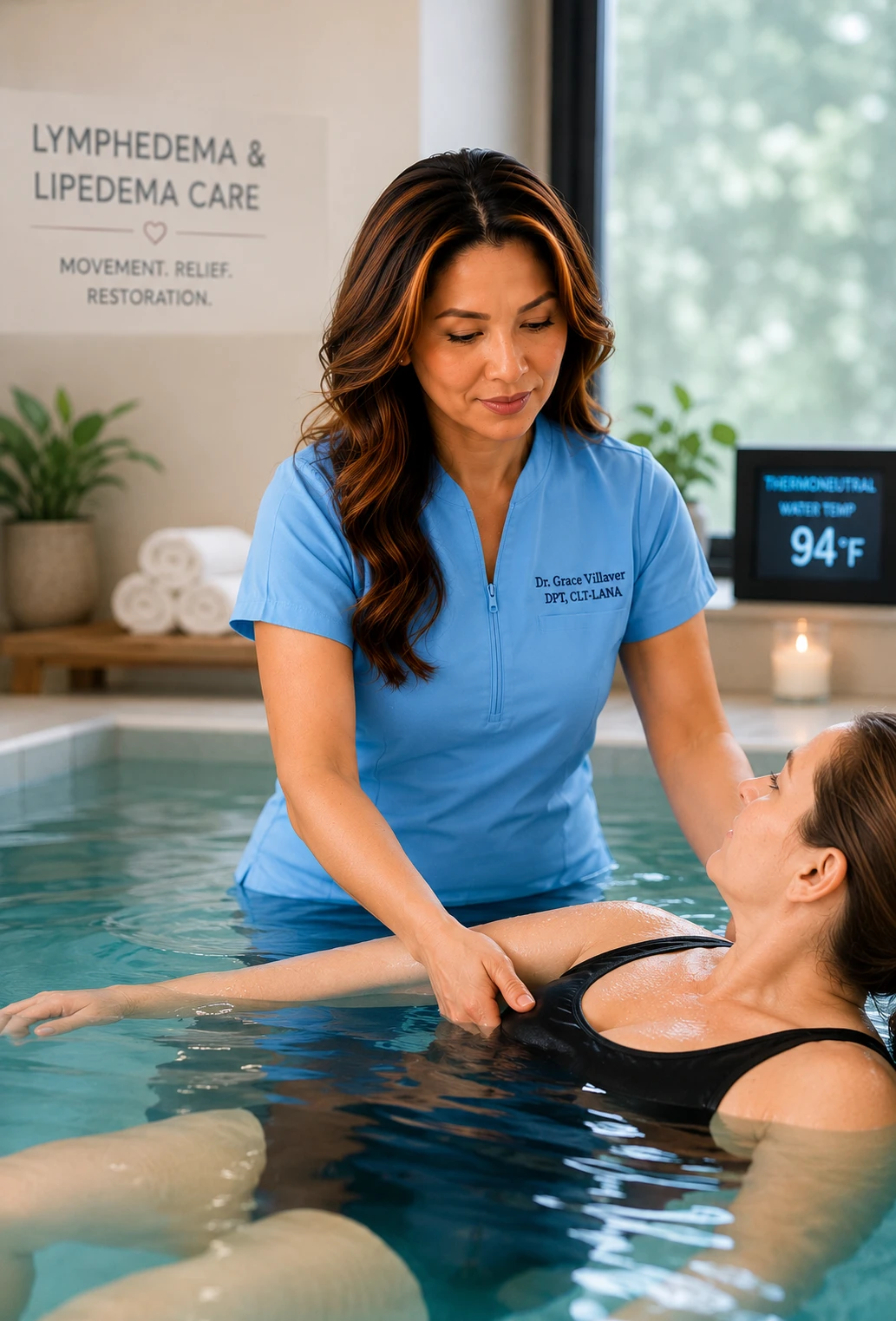
Thermoneutral aquatic therapy removes heat as an inflammatory trigger while providing hydrostatic support for lymphatic return.
Finding the Sweet Spot
Our job together is to find the level of movement that trains your lymphatic system, reduces tissue congestion, and gradually improves your body's tolerance, without tipping your immune system into a flare. The research supports this as achievable. A 2025 systematic review confirmed that exercise training can improve pain, lower limb volumes, functional performance, and quality of life in women with lipedema, particularly when combined with compression therapy.[1] You can read more about how I combine these approaches in my lymphedema and lipedema therapy overview.
Here is how we do it:
We keep intensity low and deliberate. I target a perceived exertion of about 2 to 4 out of 10, well below the threshold where your immune cells are more likely to overreact. That feels almost too easy at first. That is intentional.
We structure your sessions with real rest. A 1:2 or 1:3 work-to-rest ratio is not optional. Those rest windows are when the anti-inflammatory signaling your muscles produce during movement gets to do its job without being overwhelmed by the next bout of exertion.
We often start in water. A thermoneutral pool removes heat as an independent trigger, provides hydrostatic compression that supports lymphatic return, and reduces the gravitational load on your most affected tissues. For many of my lipedema patients, aquatic therapy is the first environment where they can move consistently without flaring.[1]
We integrate diaphragmatic breathing into every session. This is one of the most underappreciated tools I have. The diaphragm directly influences the intraperitoneal lymphatic system, and clinical research confirms that diaphragmatic breathing in a supported position produces measurable thoracic duct lymphatic drainage.[2] It also activates parasympathetic tone via vagal afferents, which reduces the cortisol-mediated priming that makes your immune cells more reactive in the first place.
If you have ever felt significantly worse 4 to 12 hours after working out, that is not deconditioning. That is a delayed immune response. It tells me we need to adjust the intensity, duration, environment, or timing of your sessions. It is clinical information, not a reason to stop moving entirely.
Progression is measured in weeks and months, not days. That timeline is not slow. That is the time your body actually needs to build the anti-inflammatory adaptive response before we add any load. Rushing that process is exactly how patients end up in a flare cycle that sets them back further than where they started.
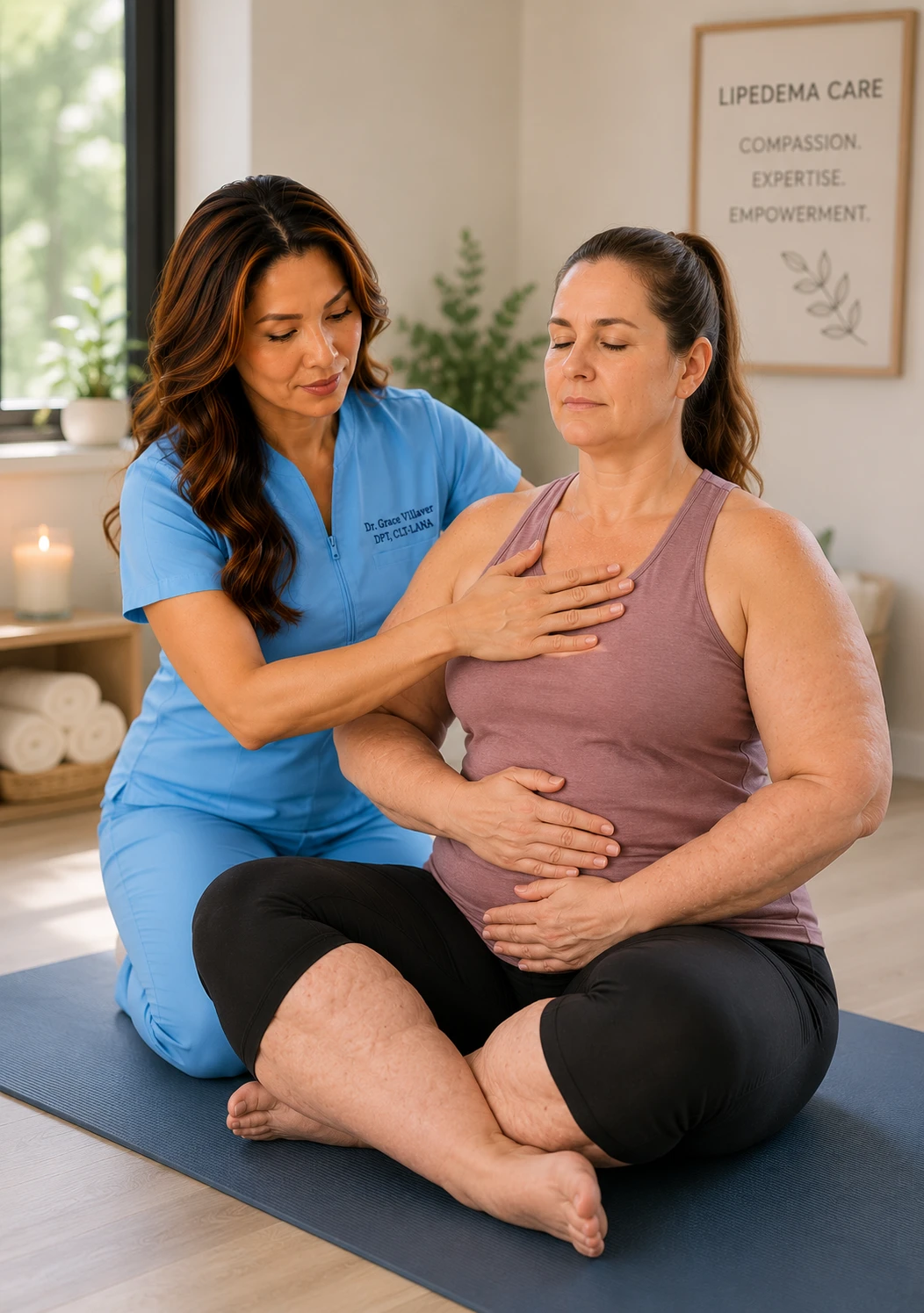
Diaphragmatic breathing is integrated into every session, not as an afterthought, but as a direct lymphatic and autonomic intervention.
The Immunological Rationale for Graded Exercise in Hyperhistaminic Patients
This section is written for the allergist, rheumatologist, immunologist, or internist co-managing a lipedema patient with a hyperhistaminic phenotype, whether from Mast Cell Activation Syndrome (MCAS), hereditary alpha-tryptasemia, systemic mastocytosis, or functional histamine intolerance. Standard exercise guidelines do not address this population adequately.
The Biphasic Cytokine Response and Where It Breaks Down
Exercise normally induces a well-characterized biphasic cytokine response. IL-6, released from contracting skeletal muscle as a myokine, drives the acute phase. Systematic review and meta-analysis confirm that IL-6 then stimulates IL-1Ra and IL-10, paradoxically shifting toward resolution during recovery in healthy individuals.[3] With consistent training over weeks to months, IL-4, IL-10, and TGF-beta establish a tolerogenic immune environment, and trained individuals demonstrate measurably blunted mast cell reactivity at baseline.[4]
In hyperhistaminic patients, the acute phase is exaggerated. Mast cells are primed via elevated surface IgE, aberrant KIT signaling (MCAS, mastocytosis), or reduced DAO/HNMT enzyme activity (histamine intolerance). Research from the Journal of Applied Physiology has confirmed that exercise produces an anaphylactoid signal in skeletal muscle: interstitial histamine increases during acute aerobic exercise through both mast cell degranulation (evidenced by elevated interstitial tryptase) and de novo histidine decarboxylase-mediated synthesis.[5] The combined catecholamine surge, mechanical tissue stress, thermal load, and local acidosis during a standard exercise session routinely cross the individual degranulation threshold in these patients.
Downstream consequences include histamine-driven TRPV1 upregulation and pain sensitization, tryptase activation of PAR-2 receptors driving neurogenic inflammation, PGD2 and LTC4 increasing vascular permeability, and TNF-alpha together with IL-33 amplifying the cascade and lowering future activation thresholds. This produces what patients experience as a "crash": post-exertional malaise, lymphatic flare, or prolonged symptom worsening typically presenting 4 to 12 hours post-session.
The Lymphatic-Immune Loop
In lipedema patients with concurrent mast cell hyperreactivity, histamine and cytokines accumulate in the interstitium, particularly in tissues with already-compromised lymphatic clearance. This co-occurs frequently with connective tissue hypermobility disorders, creating a self-amplifying loop: mast cell degranulation leads to local histamine and cytokine accumulation, increased vascular permeability, interstitial edema, reduced lymphatic velocity, prolonged cytokine exposure, and further mast cell priming. Clinically guided complete decongestive therapy and graded exercise interrupt this loop by mechanically clearing the interstitium and stimulating lymphangiogenesis through appropriate low-level loading.
Regarding diaphragmatic breathing: a peer-reviewed narrative review confirms that diaphragmatic motion directly and indirectly modulates sympathetic and parasympathetic nervous systems and is associated with cardiovascular and intraperitoneal lymphatic function.[6] A 2024 RCT in Frontiers in Oncology demonstrated that diaphragmatic breathing combined with coordinated limb training produced significant reductions in lower limb edema in patients with lymphedema following gynecologic surgery, via thoracic duct dilatation during inspiration and enhanced lymphatic return.[2]
Prescribing Parameters for This Population
- Intensity: RPE 2 to 4 out of 10, heart rate below 60 to 70% HRmax — keeps catecholamine surge below mast cell degranulation threshold
- Environment: Thermally neutral or cooled — heat is an independent mast cell trigger via TRPV channels
- Work:rest structure: 1:2 or 1:3 intervals — protects the IL-6-mediated anti-inflammatory signaling window
- Aquatic therapy: Thermoneutral water, 1 to 3 sessions per week — hydrostatic pressure aids lymphatic return and eliminates thermal provocation
- Timing and pre-medication: Morning sessions; coordinate H1/H2 pre-medication with prescribing MD — blunts the exercise-triggered degranulation cascade
- Progression rate: Weeks to months, not days — allows IL-10, IL-1Ra, and TGF-beta adaptive response to establish before increasing intensity
Monitoring Points
Where available, baseline and post-protocol serum tryptase trending helps assess systemic mast cell activation burden. Delayed reactions presenting 4 to 12 hours post-session are frequently missed as exercise-related and are the most common reason patients attribute worsening symptoms to movement itself. A structured post-exertional symptom diary across at least 12 hours post-session is essential for dose-titration decisions. Coordinate with prescribing MD on cromolin sodium, ketotifen, or low-dose naltrexone alongside exercise programming, as these agents blunt the degranulation threshold and allow meaningfully better exercise tolerance.
The goal is to shift the patient from a sensitization trajectory to a tolerance trajectory. A proof-of-principle study in Lymphatic Research and Biology confirmed that multimodal physical therapy incorporating manual techniques, exercise, and compression produced significant reduction in tissue sodium accumulation in early-stage lipedema, confirming the physiological rationale for this integrated approach.[7]
Where This Leaves Us
If you have lipedema and have been told to "just exercise more," I understand why that advice has not worked. The answer was never about working harder. It has always been about working smarter, with someone who understands the biology underneath your symptoms.
Every program I design for my lipedema patients is built around this framework. We start where your body actually is, not where a generic protocol assumes you should be. We track your responses carefully. And we progress only when the evidence in front of us says it is time.
If you want to understand more about how I approach lymphatic care from the ground up, my lymphedema and lipedema therapy page walks through the full clinical picture. And if you suspect post-surgical swelling is also part of what you are managing, the post-surgical rehabilitation page covers how I handle that alongside lymphatic care in the same treatment plan.
If you are based in Leesburg, Ashburn, or anywhere across Loudoun County and you want to start moving without the fear of a flare, I would love to talk.
References
- Braun S, et al. Exercise training in women with lipedema: A systematic review. Vasa. 2025. doi:10.1024/0301-1526/a001250
- Feng X, et al. The rehabilitation efficacy of diaphragmatic breathing combined with limb coordination training for lower limb lymphedema following gynecologic cancer surgery. Front Oncol. 2024. PMC11187277
- Cullen T, et al. Acute resistance exercise-induced changes in IL-6, IL-10, and IL-1ra in healthy adults: a systematic review and meta-analysis. medRxiv. 2023. doi:10.1101/2023.05.10.23289790
- Hanke M, et al. Circulating Myokine Responses to Acute Endurance Exercise and Their Role in Immunoregulation: A Systematic Review and Meta-analysis. PMC. 2025. PMC12885107
- Romero SA, et al. Mast cell degranulation and de novo histamine formation contribute to sustained postexercise vasodilation in humans. J Appl Physiol. 2017;122(3):603-610. PMID 27562843
- Hamasaki H. Effects of Diaphragmatic Breathing on Health: A Narrative Review. Medicines (Basel). 2020;7(10):65. PMC7602530
- Donahue PMC, et al. Physical Therapy in Women with Early Stage Lipedema: Potential Impact of Multimodal Manual Therapy, Compression, Exercise, and Education Interventions. Lymphat Res Biol. 2022;20(5):540-553. PMC9422785
