

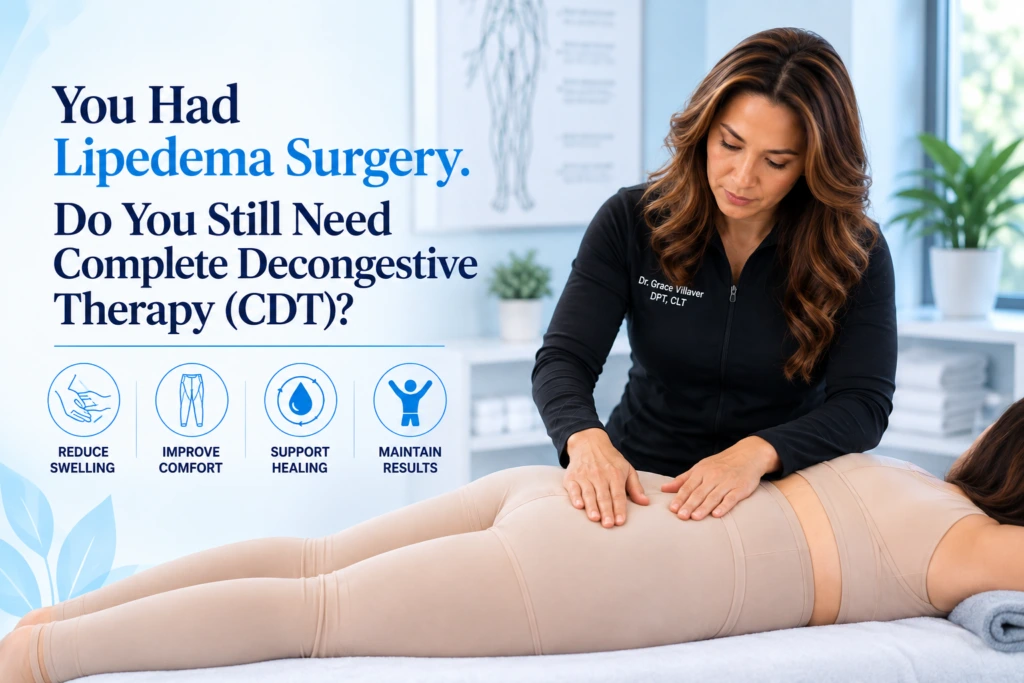
I hear this question more than almost any other from my lipedema patients who are considering or have already had surgery: if the fat is gone, do I still need to keep doing Complete Decongestive Therapy (CDT)?
It is a completely reasonable thing to wonder. Surgery is expensive, recovery is real, and the hope of stepping off the treadmill of ongoing therapy is genuine. But the research on this is both clear and more nuanced than most patients are told before their procedure.
What Surgery Actually Does and Does Not Do
Liposuction for lipedema, whether tumescent, water-assisted, or VASER, removes the abnormal subcutaneous fat that causes pain, heaviness, and disfigurement. The evidence for this is meaningful. A meta-analysis of studies from 1940 to 2023 confirmed significant post-operative improvements in spontaneous pain, edema, bruising, mobility, and quality of life following liposuction for lipedema.[1] That is real, and I do not want to minimize it.
But that same meta-analysis found that approximately 51% of patients still required conservative decongestive therapy after surgery.[1] Not a minority. About half. And this held across multiple long-term follow-up studies.
Why? Because liposuction removes fat. It does not repair the underlying condition that caused the fat to accumulate and the lymphatic system to struggle in the first place.

CDT after lipedema surgery is not a failure of the procedure. It is how you protect and maintain the results it achieved.
Lipedema Is a Chronic Condition, Not a Structural Problem You Can Remove
This is the part that does not always get communicated clearly before surgery. Lipedema involves abnormal adipose tissue at the cellular level, with documented microvascular dysfunction, chronic low-grade inflammation driven by elevated TNF-alpha, IL-6, and MCP-1, and lymphatic transport impairment that begins burdening the system even in early stages of the disease.[2] These are not features of the fat mass itself. They are features of the condition.
A 2026 scoping review across PubMed, Scopus, and Embase found that while liposuction and compression therapy both provide symptomatic relief, evidence for long-term outcomes remains limited and heterogeneous, and the review specifically flagged that evidence is insufficient to guide optimal treatment decisions around when conservative therapy can be discontinued.[3] The honest clinical picture is that we do not yet have a predictive model for which patients can safely stop CDT after surgery and which cannot.
What we do know is that the structural reasons CDT works, draining accumulated interstitial fluid, reducing chronic inflammation, supporting lymphatic clearance, and maintaining tissue pliability, do not go away with fat removal. The lymphatic vessels are still the same vessels. The microvascular dysfunction is still present. The inflammatory environment does not reset after a surgical procedure. If you want to understand why stagnant interstitial fluid matters beyond visible swelling, that piece explains the tissue-level consequences in plain terms.
A systematic review of surgical outcomes found that after 12 years of follow-up, 54% of patients still required manual lymphatic drainage and wore compression garments. Only 27% no longer required either treatment at that point.[4] Surgery reduced the need for conservative therapy in many patients. It eliminated that need in a minority.
When CDT Needs Become Reduced After Surgery
I want to be clear that surgery can meaningfully change the picture for some patients. A scoping review in Plastic and Reconstructive Surgery Global Open found that nine of thirteen included studies reported decreased compression therapy use following liposuction, and no studies reported a long-term increase.[5] That is genuinely good news. For many patients, the burden of ongoing CDT becomes lighter after surgery, sessions become less frequent, and some components can be scaled back significantly.
But "reduced need" is not the same as "no longer needed." And going into surgery expecting to stop CDT entirely, without understanding the biology underneath that expectation, sets patients up for a difficult conversation later when symptoms begin to return.
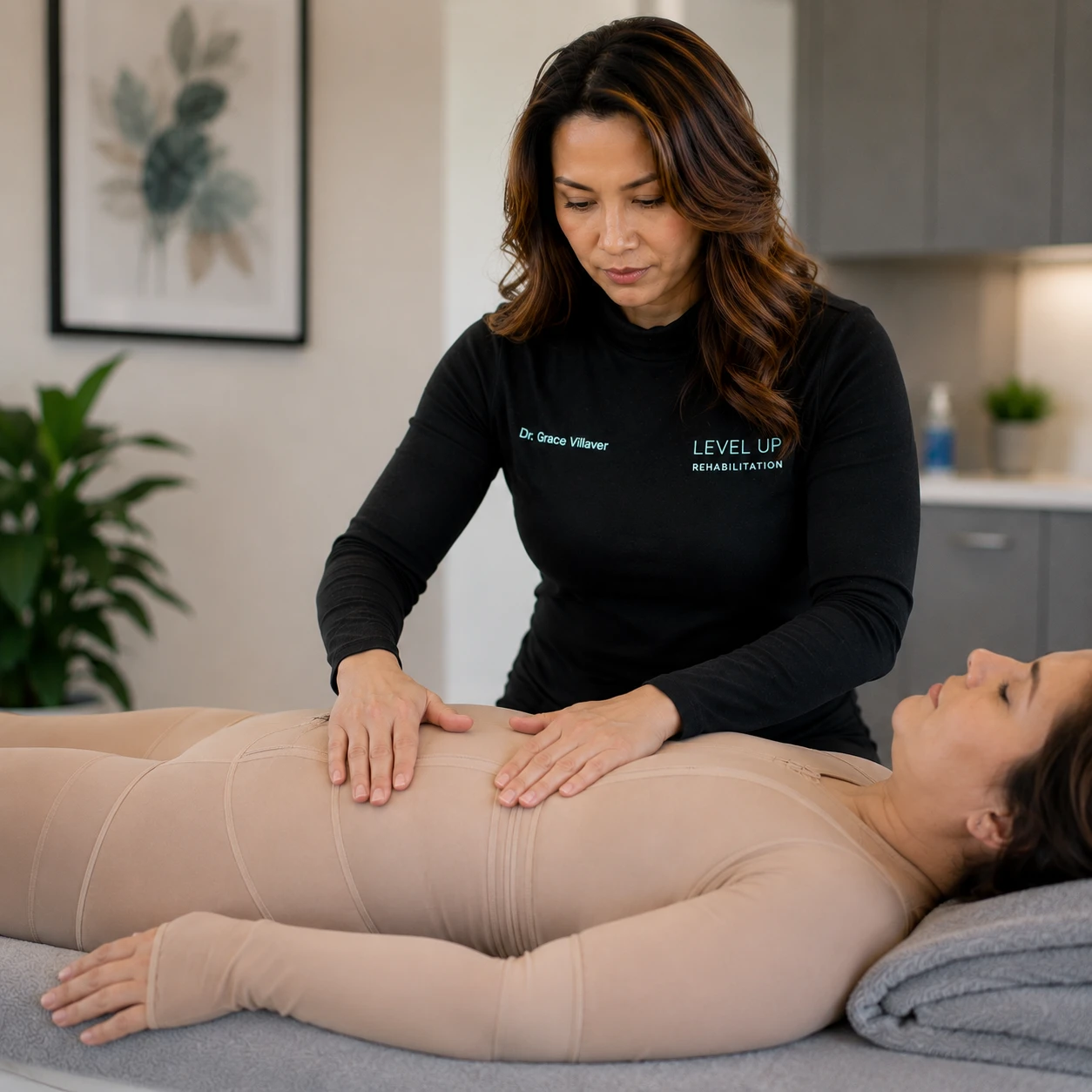
Compression guidance and MLD form the backbone of post-surgical lipedema maintenance, not as a fallback, but as active management of a chronic condition.
What This Means for Your Post-Surgical Plan
If you have had lipedema surgery or are planning it, here is what the post-surgical phase actually looks like in practice.
Immediately after surgery, CDT is not optional. A 2025 observational study of 293 patients who underwent liposuction for lipedema found that a modified CDT protocol in the postoperative period produced measurable effects on pain reduction, mobility, edema reabsorption, and prevention of complications.[6] Starting CDT early after surgery is how you protect the result the surgeon just created for you. This is not a recovery add-on. It is part of the procedure outcome.
In the months that follow, we reassess together. The goal is not to keep you on the same CDT schedule indefinitely. It is to calibrate what your body actually needs at each stage of recovery and long-term maintenance. For some patients that means transitioning to compression garments and self-care. For others it means continuing periodic MLD alongside a carefully dosed exercise program that supports lymphatic function without triggering inflammation. The answer comes from watching your tissue response, not from a fixed protocol.
CDT itself has two phases: an intensive decongestive phase delivered by a certified therapist, and a maintenance phase you carry out yourself with compression garments, self-MLD, skin care, and appropriate movement. Surgery can shift more of your care into the maintenance phase over time. What it does not do is eliminate that phase. This is exactly why reaching a plateau in your symptoms is not the same as reaching a finish line, a distinction that matters whether you have had surgery or not.
If you want to understand how I structure lipedema and lymphedema therapy both before and after surgery, that page covers the full clinical approach. If your surgeon has recommended pre-surgical CDT, the post-surgical rehabilitation page covers what that integrated plan looks like end to end. And if you are still working out what type of provider you actually need, this page explains what to look for in a certified lymphedema therapist and why the dual DPT and CLT credential changes the clinical picture significantly.
Conservative Therapy After Lipedema Surgery: What the Evidence Actually Shows
This section is written for the plastic surgeon, vascular surgeon, or internist co-managing lipedema patients through a surgical pathway. The clinical question of whether CDT can be discontinued post-liposuction is one of the most common points of misalignment between surgical and rehabilitation teams, and the evidence base deserves careful review.
The Biological Rationale for Ongoing CDT
Lipedema adipose tissue is not simply excess fat. Histological and molecular studies have established that it is characterized by adipocyte hypertrophy and hyperplasia, progressive extracellular matrix remodeling with increased collagen deposition, M2 macrophage predominance, and stage-dependent fibrosis.[7] Elevated pro-inflammatory cytokines including TNF-alpha, IL-6, and MCP-1 are consistently detected in lipedema adipose tissue, with macrophage infiltration and immune cell activation perpetuating the inflammatory and fibrotic process.[2]
Critically, lymphatic dysfunction is documented across all stages of lipedema, not only in Stage IV lipolymphedema. Lymphoscintigraphy studies demonstrate delayed lymphatic transport and increased lymphatic vessel permeability, with evidence that lipedema burdens the lymphatic system even in early-stage disease, contributing to oxidative stress, adipocyte necrosis, and further cytokine release.[2] Liposuction removes the adipose mass. It does not restore lymphatic vessel architecture, reverse microvascular dysfunction, or normalize the inflammatory cytokine environment. CDT addresses these ongoing pathophysiological processes through mechanical clearance of interstitial fluid and cytokines, compression-mediated anti-inflammatory effects, and autonomic regulation via the therapeutic components of MLD.
What the Long-Term Surgical Outcome Data Shows
A meta-analysis of studies from 1940 to 2023 established that approximately 51% of lipedema patients continue to require conservative therapy post-liposuction, with data showing a reduction in utilization compared to pre-surgical levels but persistent need in the majority of patients.[1] A systematic review published in Aesthetic Surgery Journal Open Forum found that at 12-year follow-up, 54% of patients still underwent manual lymphatic drainage and wore compression garments, 19% required fewer conservative treatments than before surgery, and only 27% no longer required either modality.[4]
A scoping review in Plastic and Reconstructive Surgery Global Open reviewing 13 studies with follow-up from 6 months to 12 years found that while nine studies reported decreased compression therapy use after liposuction, no studies reported long-term elimination of conservative therapy as a consistent outcome.[5] The most current scoping review (2026, ScienceDirect) across 16 liposuction studies concluded that evidence remains insufficient to guide optimal treatment decisions and that long-term outcome data are limited by inconsistent diagnostics and non-standardized follow-up.[3]
Clinical Implications for Peri-Operative CDT Planning
Pre-surgical CDT optimizes tissue condition, reduces fibrotic burden, and improves surgical access. Most published series required a minimum of one to two months of CDT prior to surgery as an inclusion criterion, which means the patients in these studies had already been prepared, not simply operated on. Evidence from a 293-patient observational study supports modified CDT protocols beginning in the early post-operative period, with documented effects on edema reabsorption, pain reduction, and complication prevention.[6] Starting CDT before the swelling consolidates post-operatively is not conservative caution. It is what the data shows produces better outcomes.
The Lipedema World Alliance Delphi Consensus (2023) position paper notes that not all lipedema patients require every component of CDT at all stages, and that tailoring therapeutic interventions to specific needs is appropriate. However, the consensus does not support blanket discontinuation of conservative therapy post-surgery.[8] Tailoring is not the same as stopping.
Surgical consent discussions should include realistic expectations around ongoing conservative therapy. Meta-analytic data showing 51% continued conservative therapy need post-operatively should be communicated to patients as part of informed consent, not discovered post-operatively. The mismatch between surgical expectations and post-operative reality is one of the most consistent sources of patient dissatisfaction in this population, and it is largely preventable with accurate pre-operative framing.
Coordination Between Surgical and Rehabilitation Teams
The most durable surgical outcomes in the published literature are associated with patients who maintained consistent conservative therapy before and after surgery. The framing of CDT as something to escape via surgery creates post-operative non-adherence and earlier symptom recurrence. A more clinically accurate framing is that surgery alters the burden of conservative therapy, potentially significantly, but does not eliminate the underlying biological rationale for it.
If you are co-managing a patient through lipedema surgery in Loudoun County or Northern Virginia and would like to coordinate a pre- or post-surgical CDT plan, I am available for clinical consultation.
What Surgery Changes and What It Does Not
Surgery for lipedema can be genuinely life-changing. It can reduce pain, improve mobility, decrease the volume of tissue you are managing, and in many cases meaningfully reduce how much ongoing therapy you need. It deserves to be part of the conversation for patients who have not responded adequately to conservative measures alone.
But lipedema is a chronic condition. The biology that drives it does not leave with the fat. For most patients, CDT after surgery shifts from intensive management to maintenance management. That is a real and meaningful change in burden. It is not the same as stopping. If you are still building your understanding of what drives the swelling in the first place, this overview of swelling and what it actually signals is a good place to start.
If you are preparing for surgery, recovering from it, or trying to understand what a realistic long-term plan looks like, reach out here and we can talk through where you are and what actually makes sense for your situation.
References
- Moussa M, et al. Efficacy of Liposuction in the Treatment of Lipedema: A Meta-Analysis. PMC. 2024. PMC10981502
- Paolacci S, et al. Lipedema and obesity: A narrative review and treatment protocol. PMC. 2025. PMC12936841
- Verhoven RM, et al. Treatment strategies for lipedema: A scoping review on liposuction, compression therapy, bariatric surgery, and pharmacologic treatment. ScienceDirect. 2026. doi:10.1016/S2950-1989(26)00037-1
- Gould DJ, et al. Safety and Efficacy of Surgical Techniques in Treating Lipedema: Systematic Review. Aesthet Surg J Open Forum. 2024. doi:10.1093/asjof/ojag039
- Adamo C, et al. Liposuction as a Treatment for Lipedema: A Scoping Review. Plast Reconstr Surg Glob Open. 2024;12(7). doi:10.1097/GOX.0000000000005924
- de Godoy JM, et al. Physiotherapy Intervention in the Immediate Postoperative Phase of Lipedema Surgery: Observational Study. J Clin Med. 2025;14(7):2137. doi:10.3390/jcm14072137
- Steckmeier S, et al. Lipedema and adipose tissue: current understanding, controversies, and future directions. Front Cell Dev Biol. 2025. doi:10.3389/fcell.2025.1691161
- Bertsch T, et al. Lipedema World Alliance Delphi Consensus-Based Position Paper on the Definition and Management of Lipedema. PMC. 2023. PMC12796449
