

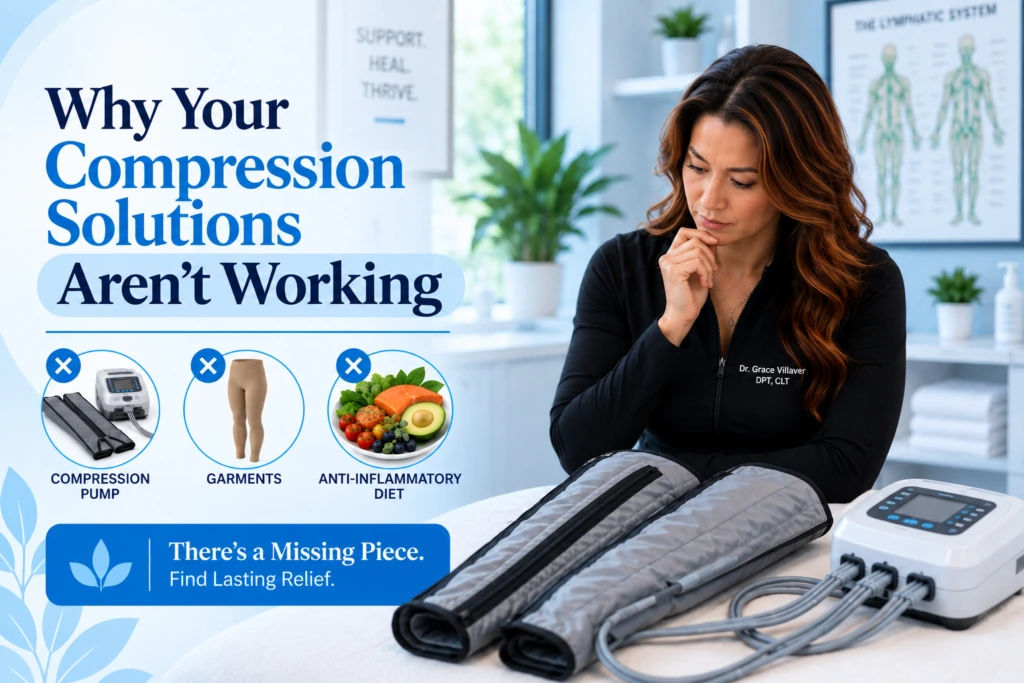
Three of the most common things I hear from patients who have been managing lymphedema or lipedema on their own for a while:
I have a compression pump and I use it every day, but my swelling is not getting better. I wear my compression garments consistently, but the volume keeps coming back. I changed my diet to anti-inflammatory and I am doing everything right, but nothing is shifting.
Each of these patients is doing something real and clinically valid. And each of them is doing it alone, which is why it is not enough. Complete Decongestive Therapy (CDT) is the gold standard for managing lymphedema and lipedema, and its defining characteristic is that it works as a system. Remove one component and the system underperforms. Remove two and you are essentially managing a chronic progressive condition with a partial tool.
What CDT Actually Is
CDT consists of four core components: manual lymphatic drainage (MLD), compression therapy, therapeutic exercise, and skin care and education. An expert consensus document from a multidisciplinary group of fourteen clinicians and researchers established ten consensus statements for Phase I of CDT, and at the foundation of all ten is the principle that these components work together, not independently.[1] A systematic review of CDT from 2004 to 2011 confirmed that CDT is effective as a bundled intervention, and explicitly noted that the contribution of any single component in isolation is difficult to determine, because it is the combination that produces the outcome.[2]
This is where most self-directed protocols fall apart. Patients find one piece that makes sense, start using it, and wonder why the results do not match what they read about. Compression holds fluid in check. MLD moves it through damaged lymphatic architecture and creates new drainage pathways. Exercise activates the muscle pump that keeps lymph flowing between sessions. Skin care closes the door on infection, which can undo weeks of progress in a matter of days. Take any one of those out and the remaining three are doing more than they were designed to do on their own.
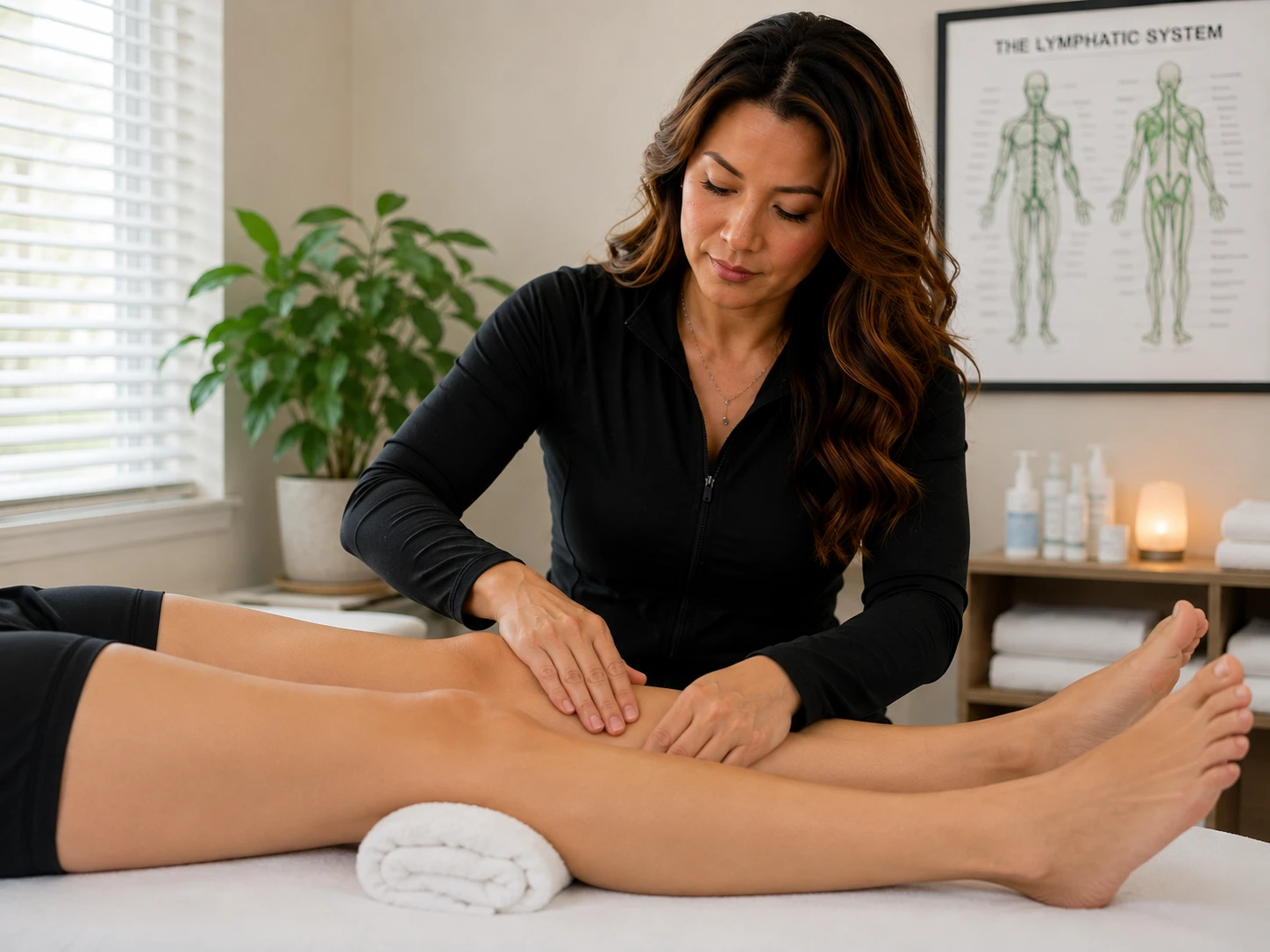
CDT works as a system. Manual lymphatic drainage, compression, exercise, and skin care each have a distinct role, and each depends on the others being present.
Why Your Compression Pump Alone Is Not Enough
A compression pump moves fluid out of the limb mechanically. It does this reasonably well, and in the right clinical context, as part of a full CDT plan, it has a documented role in the maintenance phase of management. A rapid review of compression therapies in lymphedema found evidence supporting compression pump use specifically during the maintenance phase, used alongside, not instead of, other components.[3]
The problem with using the pump as the primary intervention is that moving fluid out of the limb is only one part of the task. MLD performed by a certified therapist works differently from a pump. It stimulates the superficial lymphatic capillaries through specific manual techniques, creates new drainage pathways around damaged nodes, and begins breaking down fibrotic tissue. A pump cannot replicate this. It can assist the return of fluid. It cannot reroute lymphatic flow around damaged anatomy, which is precisely what is required in lymphedema.
Equally, without compression garments worn between pump sessions to maintain the volume reduction achieved, the fluid returns. Pump sessions produce temporary decompression. Garments maintain it. Without garments, you are cycling through decompression and re-accumulation repeatedly without building durable progress.
Why Compression Garments Alone Are Not Enough
Compression garments are the mainstay of lymphedema self-management in Phase II, the maintenance phase, and they are clinically essential. A 2024 consensus document on the essential components of the CDT maintenance phase confirmed that compression therapies are the cornerstone of self-management, and that poor adherence to compression is directly associated with increased limb volume and progression to more advanced stages of lymphedema.[4]
But garments maintain a volume reduction that has already been achieved. They hold a gain, they do not produce one. In a limb that has not been adequately drained through Phase I, consistent garment wear compresses a congested baseline rather than a treated one. Patients who go directly to garments without completing Phase I find they are working hard at maintenance without the reduction that makes maintenance meaningful.
"By my second treatment session, I could already see and feel a noticeable difference in my swelling legs, pain, and overall comfort. What I appreciate most is that she doesn't just provide treatment, she takes the time to educate you about lipedema and teaches you techniques you can do at home to support your progress between sessions."
Why an Anti-Inflammatory Diet Alone Is Not Enough
This one comes up often and deserves a direct answer, because it is both completely true and widely misunderstood. Diet matters in lipedema and lymphedema management. An anti-inflammatory nutritional approach can reduce the systemic inflammatory burden that worsens lymphatic congestion, ease pain, and support the tissue environment in which your lymphatic system is trying to function. None of that is small.
What diet cannot do is move lymphatic fluid. The lymphatic system moves fluid through a combination of intrinsic vessel contractility, muscle pump action, and manual stimulation. Food does not access those mechanisms. Reducing systemic inflammation makes the environment more favorable for lymphatic function, but it does not replace the mechanical work that CDT performs. In the same way that taking an anti-inflammatory medication does not drain a swollen ankle, an anti-inflammatory diet does not drain congested lymphatic tissue. It supports the conditions under which that drainage can happen. CDT performs the drainage itself.
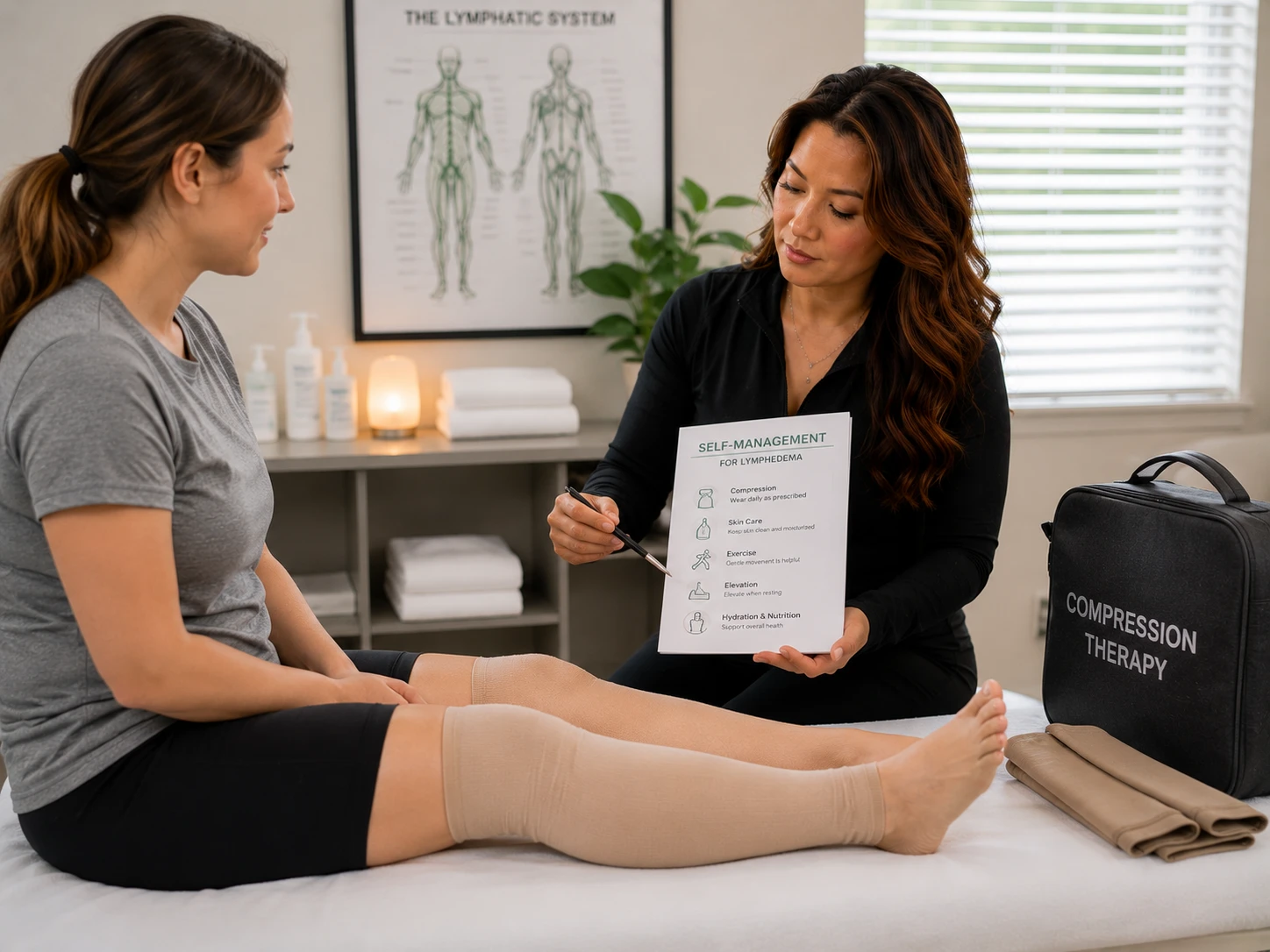
Phase II maintenance is built on what Phase I achieves. Self-management tools work best when the foundation has been properly established first.
The Two Phases, and Why Both Matter
CDT operates in two distinct phases, and conflating them is one of the most common reasons patients plateau without understanding why.
Phase I is the intensive decongestive phase: frequent clinical sessions, typically multiple times per week, in which a certified lymphedema therapist delivers MLD, applies multilayer bandaging, and guides therapeutic exercise and skin care alongside the patient. This phase is clinically supervised and time-bounded, and its purpose is measurable volume reduction. Studies have reported average reductions of 31% to 46% in well-structured intensive protocols.[5] Phase II only works if Phase I did its job first.
Phase II shifts toward sustained self-management: compression garments worn through the day and night, self-MLD techniques you have been trained to perform, exercise dosed carefully enough not to trigger inflammatory setbacks, skin care, and periodic check-ins with your therapist when something changes. The 2024 consensus on CDT maintenance is direct on this: the goal is lifelong control, which in practice means the maintenance phase never fully ends, it just becomes less demanding as your tissue stabilises.[4]
Patients who jump into Phase II tools like pumps and garments without completing Phase I properly are trying to maintain a volume they have not yet achieved. Patients who complete Phase I but abandon Phase II find that the volume comes back, because without ongoing compression and self-management, the lymphatic system returns to its pre-treatment pattern. Poor adherence to Phase II self-management practices is directly associated with volume increase and progression to more advanced stages.[4]
Whether it is a compression pump, garments, or diet, the pattern is the same: one component of CDT used without the others, or Phase II tools applied before Phase I has been completed, produces partial results. CDT was built as a protocol because the research showed that is how it works. That is not a design flaw in any individual tool. It is how the condition requires treatment.
Constance came in wanting to move better and stop hurting. What made the difference, by her account, was that the plan was built around what her body was actually doing, not a protocol designed for someone else's condition at a different stage.
"Grace has developed a plan for me that fits my schedule and lifestyle. The improvement I've seen is beyond my expectations. She is a permanent part of my wellness plan."
If you have been using one or two components and wondering why the swelling is not responding the way you hoped, the answer is almost certainly in what is missing from the protocol rather than in the component you are already using. A certified lymphedema therapist can assess where you are in the two-phase framework, identify what is absent from your current approach, and build the complete plan around your specific anatomy and stage of management. Reach out here and we can start with an honest look at the full picture.
CDT as a Bundled Intervention: Why Component Isolation Underperforms
This section is written for the physician, nurse practitioner, or allied health provider referring patients with lymphedema or lipedema for management. The most common referral gap I encounter is patients arriving having been given one or two CDT components without a supervised Phase I course, often because the referring provider was not aware of the distinction between Phase I and Phase II, or because access to a certified lymphedema therapist was limited. The outcome is predictable: Phase II tools applied to a Phase I problem.
The Evidence for CDT as a System
A systematic review of CDT evidence across 11 major medical indices confirmed that CDT is effective as a bundled intervention, and noted that the strongest trial outcomes came from evaluating the complete protocol rather than isolated components, precisely because the contribution of any single element is difficult to separate from the others.[2] A 2024 expert consensus from fourteen multidisciplinary specialists went further, establishing that Phase I CDT requires all four components to function as intended, and that the sequencing and clinical delivery of those components cannot be replicated through patient-directed self-management alone.[1]
A narrative review of CDT adherence challenges found that the complexity and time demands of daily CDT regimens lead to psychological fatigue and suboptimal compliance, with long-term success heavily dependent on sustained maintenance and active clinical support.[6] Patients sent home with a pump and garments without completing a supervised Phase I course arrive at Phase II without the manual training, self-MLD technique, or behavioral scaffolding that makes Phase II adherence achievable. This is a structural gap, not a motivation gap.
The Two-Phase Framework in Clinical Practice
Current consensus on Phase I confirms that the intensive decongestive phase targets maximal volume reduction through frequent clinical sessions combining MLD, multilayer short-stretch bandaging, exercise, and skin care delivered by a certified lymphedema therapist.[1] Once that reduction is achieved, Phase II takes over: the patient manages compression daily, practices self-MLD at home, follows a dosed exercise plan, and returns for clinical recalibration when the tissue changes. What Phase II cannot do is compensate for a Phase I that was skipped or abbreviated. Garments compress whatever volume is present. If that volume was never reduced through supervised treatment, consistent garment wear compresses the wrong baseline.
Poor Phase II adherence is directly linked to volume increase and disease progression.[4] The hands-on training, self-MLD technique work, and exercise guidance that Phase I delivers are not supplementary to the volume reduction — they are what determines whether the patient can maintain it independently. Patients who receive garments before completing Phase I have the tool without the education that makes the tool work.
Lipedema-Specific Considerations
In lipedema, the relative weighting of CDT components shifts compared to secondary lymphedema, but the bundled principle is the same. Compression carries significant mechanical load. MLD addresses the lymphatic burden generated by abnormal adipose tissue and the chronic low-grade inflammation in it. Exercise dosage requires clinical precision to avoid triggering mast cell and inflammatory responses that worsen lymphatic congestion, particularly in patients with MCAS-adjacent presentations. Nutrition matters: anti-inflammatory dietary approaches reduce the systemic inflammatory burden and improve the tissue environment. What nutrition cannot do is replace any of the mechanical components. The Lipedema World Alliance Delphi Consensus (2023) supports a multimodal approach in which all four CDT components and nutritional guidance operate together, each doing something the others cannot.[7]
For patients with both lipedema and secondary lymphedema, the CDT framework applies with additional attention to the specific drainage territories involved and the presence of any contraindications reviewed in prior clinical communication. If you are co-managing a patient through CDT in Loudoun County or Northern Virginia and would like to coordinate Phase I or Phase II planning, I am available for clinical consultation. The approach I use for lymphedema and lipedema therapy integrates all four components across both phases rather than addressing them in isolation.
Partial Protocols Produce Partial Results
Using a pump every day, wearing garments consistently, eating an anti-inflammatory diet — none of these are wrong. Each one is addressing a real aspect of the condition. What they cannot do together, without MLD and the full Phase I course behind them, is produce and sustain the volume reduction that CDT as a system is designed to achieve. The tools are doing what they can. The system they belong to is incomplete.
Lauren described what changes when the full framework is in place, not just the symptom management in the short term, but the sense of agency over a condition that can otherwise feel completely unmanageable.
"Entrusting Dr Grace with my lipedema therapy has been life changing. She doesn't just treat your symptoms but empowers you to continue care at home. She is the best."
If your swelling is not responding and you are already doing something consistently, the missing piece is worth finding. Reaching a plateau is not the same as reaching the ceiling of what is possible. It usually means the system is incomplete. Reach out here and we can work out what that means for your specific situation.
References
- Armer JM, et al. Complete decongestive therapy phase 1: an expert consensus document. Med Oncol. 2024. doi:10.1007/s12032-024-02407-4
- Lasinski BB, et al. A systematic review of the evidence for complete decongestive therapy in the treatment of lymphedema from 2004 to 2011. PM R. 2012;4(8):580–601. PMID 22920313
- Wanchai A, et al. The effect of compression therapies and therapeutic modalities on lymphedema secondary to cancer: a rapid review and evidence map. PMC. 2024. PMC11486789
- Armer JM, et al. Essential components of the maintenance phase of complex decongestive therapy. Med Oncol. 2024. doi:10.1007/s12032-024-02442-1
- Dini D, et al. Complex Decongestive Therapy in the Management of Breast Cancer-Related Lymphedema: Benefits and Future Perspectives. BioNatura Journal. 2025. doi:10.21931/bionatura/2025
- Harrington S, et al. Technology-enhanced compression and AI-integrated lymphedema care: a narrative review. PMC. 2025. PMC12769965
- Bertsch T, et al. Lipedema World Alliance Delphi Consensus-Based Position Paper on the Definition and Management of Lipedema. PMC. 2023. PMC12796449
