

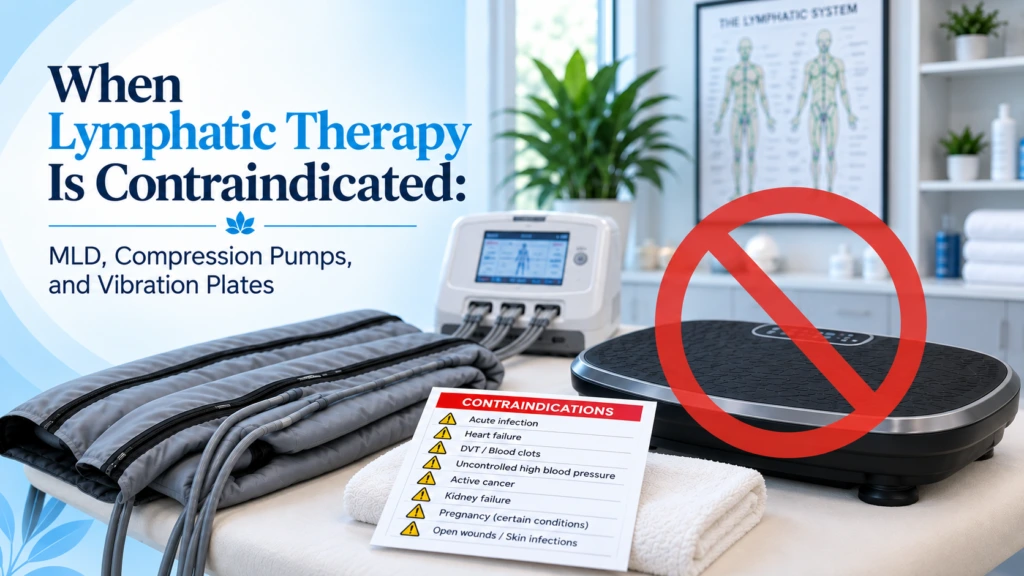
Three tools come up frequently in conversations about lymphatic care outside of the clinic: manual lymphatic drainage performed by a therapist, compression pumps used at home, and vibration plates. Each has a legitimate role in specific clinical contexts. Each also has a contraindication profile that most people never encounter before they try one.
This post covers what those contraindications are, why they matter physiologically, and who needs a clinical assessment before going near any of these three tools. The goal is not to discourage use. It is to make sure that when these tools are used, they are safe, appropriately timed, and working in the right direction.

A thorough assessment before any lymphatic intervention is not a formality. It is the step that determines whether the intervention is safe.
Manual Lymphatic Drainage (MLD)
Manual lymphatic drainage is a specialized hands-on technique that uses light, rhythmic strokes to stimulate the superficial lymphatic system, encouraging fluid to move from congested areas toward functioning lymph nodes and ultimately back into circulation. When applied by a certified therapist at the correct pressure and sequence, it is one of the most effective tools in lymphedema and lipedema management. When applied in the wrong clinical context, it accelerates exactly the problem it is meant to solve.
Active infection is the clearest contraindication. Acute cellulitis, erysipelas, acute lymphangitis, or any systemic infection with fever rules out MLD until the infection has been treated and resolved. The reason is straightforward: MLD increases lymphatic and circulatory flow through the treated area. In the presence of an active infection, that increased flow can spread pathogens through tissue planes and into the bloodstream, converting a localized infection into a systemic one. If you have warmth, spreading redness, or fever alongside your swelling, MLD is not the first intervention. Medical treatment is. Understanding what your swelling is telling you matters precisely for situations like this, where the clinical picture looks similar but the appropriate response is completely different.
Untreated cardiac failure is another absolute contraindication. MLD mobilizes significant volumes of interstitial fluid back into systemic circulation. In a heart that is already failing to manage its current circulating volume, adding to that load can precipitate decompensation, pulmonary edema, or hemodynamic instability. This does not mean that patients with a cardiac history cannot receive MLD. It means that cardiac function needs to be assessed and the condition needs to be medically managed before MLD is appropriate. A heart that is compensated and medically stable is a different clinical situation from untreated or decompensated failure.
Acute deep vein thrombosis (DVT) is also an absolute contraindication. MLD could potentially dislodge a thrombus and cause it to travel to the pulmonary vasculature. If there is any clinical suspicion of DVT, including sudden unilateral swelling, calf pain, or warmth, treatment should not proceed until DVT has been ruled out by imaging. Renal failure and severe thyroid dysfunction are relative contraindications that require clinical judgment and coordination with the patient's physician before proceeding.
Active malignancy in the treatment area requires specific discussion. This is a relative contraindication in most clinical guidelines, not an absolute one. The theoretical concern is that MLD could promote the spread of malignant cells through the lymphatic system. In practice, MLD is routinely and safely used in patients with cancer-related lymphedema. The clinical picture matters: active, untreated disease in the region being drained warrants oncology consultation before MLD. Post-treatment cancer patients with established lymphedema are a different category entirely, and withholding MLD from them is often the greater clinical risk.
"She was the first to truly listen with compassion. She helped relieve my discomfort from inflammation and swelling, and I felt better almost immediately. She honestly helped give me my life back."
Compression Pumps (Intermittent Pneumatic Compression)
Intermittent pneumatic compression (IPC) pumps apply sequential mechanical pressure to a limb through an inflatable sleeve, simulating the pumping action of muscle contraction to move fluid out of the extremity. They are widely used in home management of lymphedema and chronic edema. They are also, in certain clinical contexts, genuinely dangerous.
Congestive heart failure is the most significant contraindication, and it is listed as an absolute contraindication in multiple clinical guidelines on IPC use.[4] The mechanism mirrors the concern with MLD: IPC moves substantial fluid volume from the limb into central circulation. In a patient with uncontrolled CHF, that sudden fluid shift can worsen pulmonary congestion and precipitate acute decompensation. The 2018 guidelines on sequential compression cited in a peer-reviewed evidence synthesis explicitly listed congestive heart failure as an absolute contraindication to IPC, and noted that even severe or uncontrolled hypertension poses risk through a similar mechanism.[4]
Peripheral arterial disease (PAD) is a more nuanced contraindication. In patients with significant arterial insufficiency, compression of any kind applied to the limb can further compromise already-reduced arterial inflow, worsening ischemia. The clinical evidence on IPC in PAD is mixed: some studies have found benefit in patients with intermittent claudication who are not surgical candidates, while the standard clinical position remains that IPC should not be used in the presence of significant PAD without specific arterial evaluation and physician guidance.[5] This is exactly the kind of situation where a patient presenting with lymphedema and known PAD needs a more careful clinical picture before any pump is placed on their leg.
Active DVT or acute thrombophlebitis in the treatment limb is an absolute contraindication for the same reason as MLD: mechanical compression in the presence of an intravascular clot carries risk of embolization. Acute infection, open wounds, and skin integrity compromise in the treatment area also rule out pump use until resolved.
Many patients with lipedema and lymphedema also carry diagnoses of hypertension, venous insufficiency, or chronic kidney disease. These are not automatic contraindications to pump use, but they change the clinical picture enough that starting a home pump without assessment first is not the right move. The conditions that make your swelling worse are often the same conditions that make certain interventions riskier.
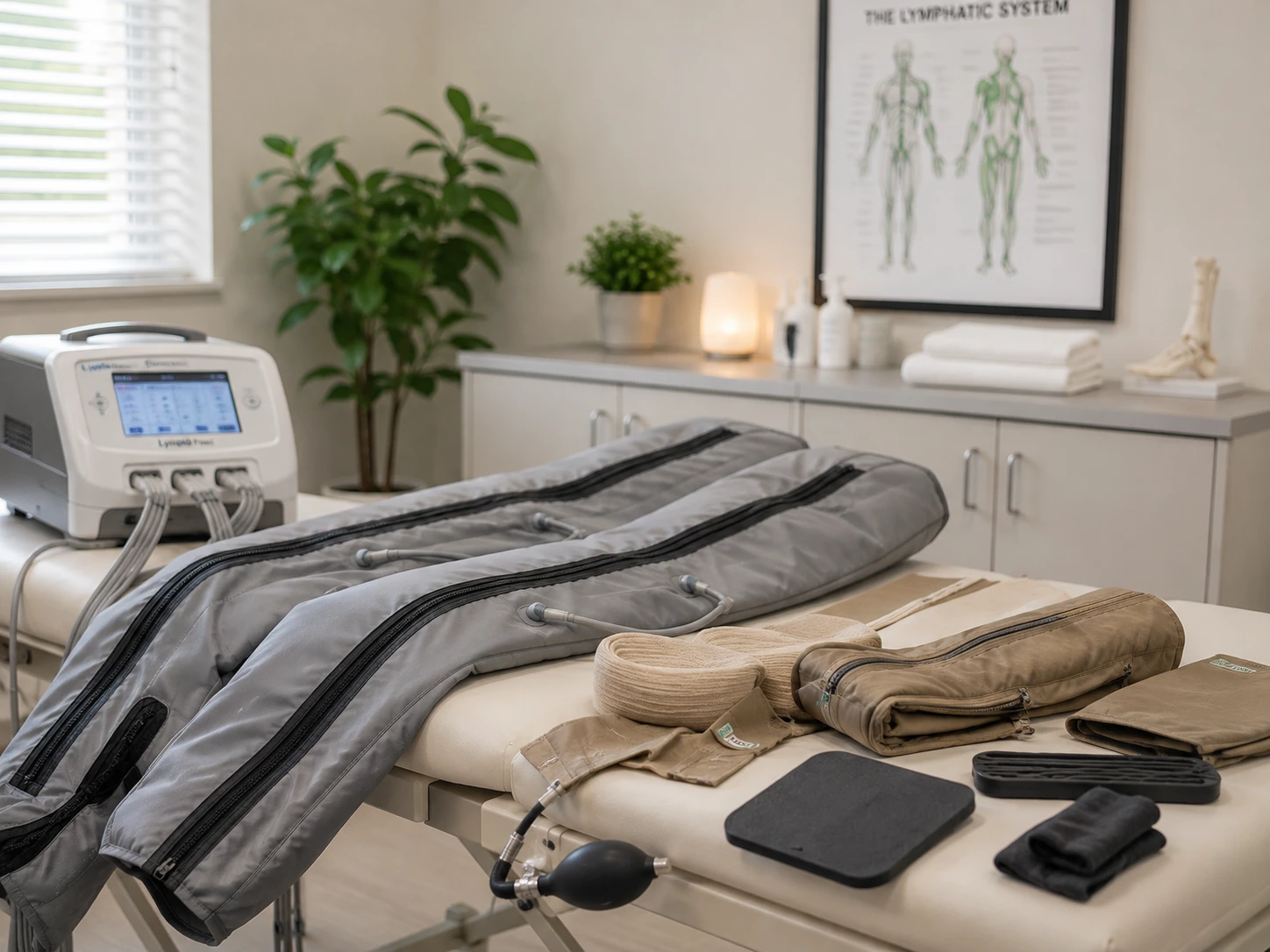
Compression pumps are effective home management tools in the right clinical context. The clinical context is the part that requires assessment.
Vibration Plates (Whole-Body Vibration)
Whole-body vibration (WBV) involves standing or sitting on a platform that oscillates at controlled frequencies, transmitting mechanical vibration through the body. It has been studied across a wide range of populations and conditions, with documented benefits in bone density, muscle function, glycemic control in type 2 diabetes, and physical function in chronic kidney disease.[6,7] Within lymphatic care specifically, the proposed benefit is that rhythmic vibration stimulates the initial lymphatics via the same mechanical principle as muscle contraction, supporting lymphatic return without requiring active exercise output.
The contraindication profile for WBV is meaningful and often underdiscussed. A systematic review of WBV and blood clotting biomarkers found no consistent evidence that WBV induces pathological clotting in healthy populations, but the safety of WBV in individuals with known thromboembolic risk or established DVT is not established, and this should be treated as a contraindication until evidence to the contrary exists.[8] The same principle applies as with MLD and IPC: promoting fluid and circulatory movement in the presence of a clot carries risk of embolization, regardless of the mechanism used to produce that movement.
Active malignancy is considered a relative contraindication for WBV. The concern is not that vibration causes cancer. There is no evidence for that. The concern is that mechanical stimulation could theoretically promote movement of malignant cells through lymphatic or vascular channels in individuals with existing disease. The evidence base here is precautionary rather than established from clinical harm, but until prospective safety data exists, oncology consultation before WBV in a patient with active disease is the appropriate step.
Cardiovascular precautions apply to WBV in ways that patients frequently do not anticipate. WBV acutely increases heart rate and blood pressure, and in individuals with arrhythmia, severe or uncontrolled hypertension, or decompensated cardiac disease, that acute cardiovascular stress is a genuine clinical concern. Fresh joint replacements, acute fractures, and significant osteoporosis with high fracture risk are also contraindications, as the mechanical loading transmitted through the skeletal system can compromise healing or provoke fracture. Pregnancy, pacemakers, and cochlear implants round out the contraindication profile in the clinical literature.
For patients with lipedema who are considering vibration plates as part of their movement strategy, the same principle applies as with clinically guided exercise more broadly: the tool itself is not the question. The question is whether it is appropriate for your specific physiology, at your specific stage of management, at the frequency and duration being proposed.
Contraindication Profiles for MLD, IPC, and WBV: A Clinical Summary
This section is written for the physician, nurse practitioner, or physical therapist co-managing patients who are using or considering manual lymphatic drainage, intermittent pneumatic compression, or whole-body vibration as part of their lymphatic or edema management plan. The contraindication profiles of these three modalities overlap substantially, and understanding where they diverge is clinically important for patients who carry complex comorbidity profiles.
Manual Lymphatic Drainage
The foundational clinical reference for MLD contraindications remains Foldi's Textbook of Lymphology, which categorizes contraindications as absolute and relative. Absolute contraindications include acute infections (bacterial, viral, or fungal) with associated fever or systemic signs, acute cellulitis and erysipelas, acute lymphangitis, untreated congestive heart failure, acute deep vein thrombosis, acute thrombophlebitis, and renal failure. Relative contraindications requiring clinical judgment before proceeding include active malignancy in the drainage territory, severe thyroid dysfunction (hyperthyroidism), renal dysfunction without frank failure, and first-trimester pregnancy.
The physiological basis for the cardiac contraindication is relevant to clinical communication with patients. MLD applied to a lower extremity can mobilize 500 to 1000 mL of interstitial fluid into the central circulation over a treatment session. In compensated cardiac disease this is manageable; in decompensated CHF or significant mitral or aortic valvular disease, the added preload can precipitate acute decompensation. For patients with cardiac history who require lymphatic management, cardiology clearance and documentation of current functional classification before initiating MLD is the appropriate sequence.
The malignancy relative contraindication requires nuanced framing in shared decision-making. Systematic review evidence confirms that MLD is safe and effective in patients with breast cancer-related lymphedema post-treatment.[1] The concern around active malignancy in the treatment region relates to the theoretical promotion of lymphatic spread in actively perfused tumor tissue. In practice, the greater clinical risk is often untreated lymphedema in a cancer survivor. The recommendation is oncology consultation to determine regional disease status before initiating drainage in any anatomical territory where active disease is suspected, not blanket exclusion of MLD from all cancer patients.
Intermittent Pneumatic Compression
A peer-reviewed evidence synthesis on contraindications to IPC identified that while approximately 60 conditions are listed as contraindications by device manufacturers and clinical tradition, evidence-based consensus among medical experts supports fewer than ten absolute contraindications.[4] Absolute contraindications with clear mechanistic or clinical evidence include: decompensated congestive heart failure, acute DVT or thrombophlebitis in the treatment limb, active cellulitis or cutaneous infection in the treatment limb, pulmonary edema, and severe or uncontrolled hypertension. Compartment syndrome and significant open soft tissue injury of the limb are also absolute contraindications.
The CHF contraindication is particularly relevant for the lymphedema and lipedema population, which carries elevated prevalence of cardiovascular comorbidity. IPC applied to bilateral lower extremities can mobilize a clinically significant fluid volume centrally over a treatment session. In patients with preserved but limited cardiac reserve, sequential lower extremity IPC applied without assessment represents a risk that deserves specific consideration rather than routine use. Clinically compensated CHF managed with diuretics is a different situation from acute decompensation, but both require physician input before IPC initiation.
The PAD question is more complex. Current clinical guidance from vascular medicine notes that IPC is contraindicated in patients with significant peripheral arterial occlusive disease, while simultaneously noting that some evidence supports IPC use in patients with intermittent claudication who are not surgical candidates.[5] The practical clinical implication is that patients presenting with lower extremity edema who also carry a diagnosis of PAD require ankle-brachial index evaluation and vascular assessment before compression of any kind is applied. Applying compressive therapy over ischemic tissue is a serious clinical risk.
Whole-Body Vibration
A systematic review of WBV and blood clotting biomarkers reviewed 33 studies meeting inclusion criteria and found no consistent evidence of pathological coagulation activation in healthy ground-based populations from WBV exposure.[8] The review was not conducted in populations with pre-existing thromboembolic risk or established DVT, and the absence of harm in healthy populations does not establish safety in high-risk ones. Current clinical positioning treats DVT, acute thrombophlebitis, and thromboembolic disease as contraindications to WBV, consistent with the precautionary principle applied to any intervention that increases circulatory and lymphatic flow.
WBV produces acute cardiovascular responses including heart rate elevation and blood pressure increase. For patients with arrhythmia, decompensated cardiac disease, or severe uncontrolled hypertension, these acute responses warrant specific evaluation before WBV is initiated. The magnitude of cardiovascular response varies significantly with vibration frequency and amplitude, and with the body position adopted during use. Contraindications related to skeletal integrity, including fresh arthroplasty within the healing window, acute or subacute fracture, and high-fracture-risk osteoporosis, are based on the mechanical loading transmitted through the skeletal system during vibration. These warrant assessment against the specific WBV protocol being used rather than blanket exclusion.
For lipedema patients with concurrent MCAS or inflammatory comorbidities, WBV represents the same dosing challenge as conventional exercise: the physiological stress response to vibration, including catecholamine release, can cross mast cell activation thresholds in sensitized patients. This is not a formal contraindication in the published literature, but it is a clinical consideration relevant to the specific population most likely to use WBV as an alternative to conventional exercise. Introducing WBV at low frequency, short duration, and cool ambient temperature, with a post-session symptom diary, follows the same graded approach recommended for therapeutic exercise in this population.
If you are co-managing a patient who is using or considering any of these three modalities and want to discuss the contraindication screen or integrate them within a structured CDT plan, I am available for clinical consultation. The approach I use for lymphedema and lipedema management incorporates all three as adjuncts within a supervised framework rather than independent self-directed tools.
The Pattern Across All Three
What MLD, compression pumps, and vibration plates share is a common mechanism: each one promotes the movement of fluid through tissue and into central circulation. That is exactly what makes them useful in lymphatic care. It is also exactly what makes them potentially harmful in the presence of conditions where the heart cannot manage additional fluid load, where a clot should not be disturbed, where an infection should not be mechanically propagated, or where a malignancy sits in the drainage territory.
The contraindications are not arbitrary caution. They reflect the same physiology that makes the tools work. Lauren described what changes when lymphatic care is done correctly and consistently: it is not simply about feeling better in the short term. It changes the trajectory of a chronic condition.
"Entrusting Dr Grace with my lipedema therapy has been life changing. Initially I was hesitant to schedule concierge care but it has truly been the best decision for my health I could have made. She doesn't just treat your symptoms but empowers you to continue care at home."
That kind of outcome depends on using the right tools, in the right order, in the right clinical context. If you are managing lymphedema or lipedema and want to understand which of these modalities belongs in your care plan and which needs a closer look first, working with a certified lymphedema therapist who can assess the full picture is where that conversation starts. Reach out here and we can work through it together.
References
- Huang TW, et al. Effects of manual lymphatic drainage on breast cancer-related lymphedema: a systematic review and meta-analysis of randomized controlled trials. World J Surg Oncol. 2013;11:15. PMC3562193
- Müller M, et al. Manual lymphatic drainage and quality of life in patients with lymphoedema and mixed oedema: a systematic review of randomised controlled trials. Qual Life Res. 2018;27(6):1403–1414. PMC5951867
- Tashiro K, et al. Manual lymphatic drainage for lymphedema in patients after breast cancer surgery: A systematic review and meta-analysis of randomized controlled trials. Medicine (Baltimore). 2020. PMC7717855
- Pavon JM, et al. Contraindications to Intermittent Pneumatic Compression: Between Lines of Recommendations. ResearchGate. 2023. doi:10.researchgate.376050690
- Delis KT, Nicolaides AN. Effect of intermittent pneumatic compression of foot and calf on walking distance, hemodynamics, and quality of life in patients with arterial claudication. Ann Surg. 2005;241(3):431–441. PMID 15729070
- Fabregat-Fernández J, et al. Whole body vibration therapy and diabetes type 2: a systematic review and meta-analysis. Front Endocrinol. 2024. PMC11457016
- Liao CD, et al. Effects of whole-body vibration exercise on physical function in patients with chronic kidney disease: a systematic review and meta-analysis. BMC Nephrol. 2024. PMC10763333
- Belavý DL, et al. Effects of whole-body vibration or resistive-vibration exercise on blood clotting and related biomarkers: a systematic review. npj Microgravity. 2023. PMC10700556
