

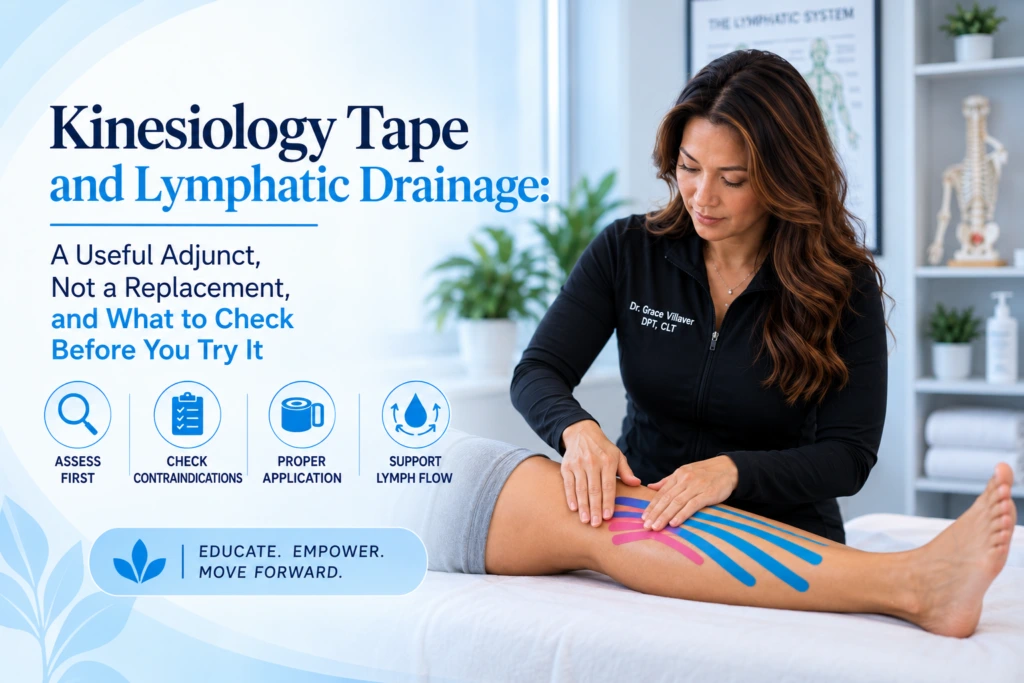
Kinesiology tape has become one of those things patients bring up frequently, usually after seeing it on social media or noticing it on someone at their gym. The colorful strips applied in fan patterns over swollen limbs look promising, and the question I hear regularly is: should I be using this instead of my sessions?
It is not a replacement for Complete Decongestive Therapy (CDT), manual lymphatic drainage, or compression garments. Kinesiology tape, or KT, has a legitimate place in lymphatic care as an adjunct, meaning it works alongside your primary treatment, not instead of it. And before you try it, there are clinical precautions that most people skipping ahead to a YouTube tutorial never encounter.
What Kinesiology Tape Actually Does
The proposed mechanism is mechanical. An elastic tape applied with light tension to the skin creates a subtle lifting effect on the superficial tissue layers. This is thought to open the initial lymphatics by reducing local interstitial pressure, encouraging fluid movement toward less congested drainage pathways. The tape moves with the body throughout the day, creating a dynamic rather than static pressure, which is part of why it differs from a compression garment.
The research on this is specific. A 2024 systematic review and meta-analysis of 14 randomized controlled trials found that kinesiology taping produced statistically significant improvements in upper limb functional assessment and quality of life in patients with breast cancer-related lymphedema, but did not demonstrate significant improvement in lymphedema severity as measured by limb volume.[1] A separate systematic review and meta-analysis found that KT led to measurable reductions in edema volume, pain, and improved range of motion compared to compression garment alone, but also confirmed that it could not replace multilayer compression bandaging as the foundational intervention.[2]
Tape can improve how a limb feels and functions. It has not been shown to produce the same volume reduction as CDT. These are different clinical goals, and conflating them leads patients to undertreat a progressive condition.
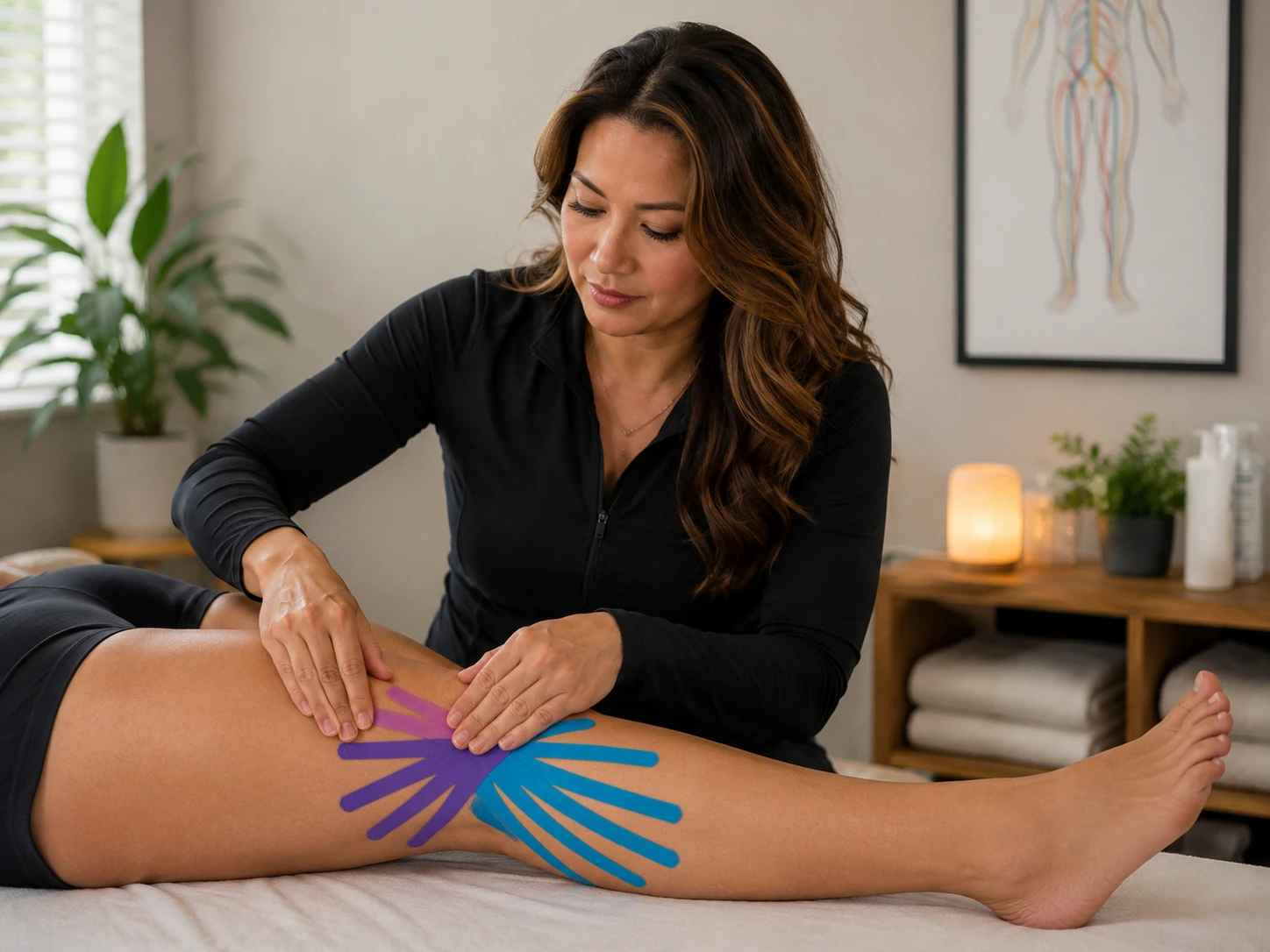
Kinesiology tape applied correctly can support lymphatic drainage between sessions. It works alongside CDT, not instead of it.
Where It Actually Fits in a Care Plan
I use kinesiology tape with certain patients as a between-session tool, particularly during the maintenance phase of CDT when they are managing well with compression garments and self-MLD but need additional support for specific areas or during activity. It can also be useful in early post-surgical settings where traditional bandaging is difficult to tolerate, or during periods when the skin is managing well but the patient needs something lighter than a full compression wrap for daily movement.
Reema, one of my lipedema patients, described the early shift in her symptoms when we combined manual drainage sessions with at-home techniques I taught her between visits. That pattern, clinical sessions anchoring the care plan with supported self-management in between, is exactly how I think about tape as well. It extends the benefit of a session. It does not replace one.
"By my second treatment session, I could already see and feel a noticeable difference in my swelling legs, pain, and overall comfort. What I appreciate most is that she doesn't just provide treatment — she takes the time to educate you about lipedema and teaches you techniques you can do at home to support your progress between sessions."
The same principle applies to tape. When patients understand why each tool exists in their care plan and what it is designed to do, they use it more accurately and get more from it. Evie, a trained nurse who came to me for lymphatic work, reflected on exactly this after her sessions: learning the reasoning behind each technique changed how she engaged with her own care between appointments.
"She teaches every step to you so that you can do it on your own and feel independent to take charge of your own care. She explains everything so well, and I better understand my body because of it. As a trained nurse, I had no idea!"
Precautions You Must Know Before Trying It
This is the part that gets skipped when people order tape from Amazon and follow a YouTube tutorial. Kinesiology tape is not universally safe for lymphatic conditions, and applying it without assessment first is a genuine clinical risk.
The first thing to assess is whether there is any active infection. If your skin is showing signs of cellulitis, spreading redness, or localised warmth, tape must not go on. The mechanical effect of tape over infected tissue can facilitate spread through the superficial layers. Understanding what your swelling is telling you is part of knowing when tape is appropriate and when it is a contraindication.
Skin integrity is the next consideration, and in lipedema and lymphedema it is rarely straightforward. Open wounds, abrasions, active dermatitis, and radiation dermatitis all rule out tape until the tissue has healed. A safety and tolerability study of KT in arm lymphedema patients found that even in appropriately selected patients, 4.2% experienced skin peeling and redness.[3] That is a manageable rate when patients are screened first. It becomes a more serious problem when they are not.
If there is any possibility of deep vein thrombosis, tape is contraindicated until it has been ruled out. Mechanical stimulation of fluid movement in the presence of a clot carries real risk, and this is not a situation to manage with a consumer product. Similarly, tape should not be applied over a known or suspected malignancy in the treatment area. The research base for KT in lymphedema draws almost entirely from post-treatment cancer patients, not from those with active disease.[2]
Adhesive sensitivity is something I check with every new patient, particularly in lipedema where skin reactivity is often elevated. A patch test on a small area for 24 hours before full application is standard practice here, not an optional step. Some patients do well with latex-free tape formulations when standard tape provokes a reaction. And if you have any areas of reduced sensation, you may not detect early signs of a reaction under the tape, which requires either closer monitoring or avoiding those areas altogether.

Skin assessment before tape application is not optional. The precaution screen determines whether tape is appropriate, and in which areas.
What It Cannot Replace
No comparative trial has shown tape producing the volume reduction that CDT delivers. A systematic review of kinesiotaping for postoperative edema found some positive results but flagged that all available trials were compromised by methodological limitations, and that comparison against standard of care as an active comparator remains lacking.[4] The 2025 systematic review of KT in post-mastectomy patients confirmed efficacy in pain, functional status, and quality of life, while reiterating that the evidence base remains limited and heterogeneous.[5]
Manual lymphatic drainage performed by a certified therapist works at a depth and specificity that tape cannot replicate. Multilayer compression bandaging produces volume reduction at a level tape has not matched in any comparative trial. A certified lymphedema therapist brings clinical judgment about which tools belong in your care plan and in what sequence. Tape is one of those tools. It is not the plan itself.
Remie, who came to me with significant inflammation and swelling, described feeling better almost immediately after her first session. That kind of result comes from the full clinical intervention, not from a strip of elastic tape applied at home. Tape can help maintain between sessions what the session itself creates.
"I'm so grateful for Dr. Grace. She was the first to truly listen with compassion. She helped relieve my discomfort from inflammation and swelling, and I felt better almost immediately. She honestly helped give me my life back."
If you are managing lymphedema or lipedema and want to understand whether kinesiology tape has a role in your specific plan, and what that role looks like alongside your existing care, my lymphedema and lipedema therapy page covers the full clinical approach I use. And if you are earlier in your care journey and still building your understanding of how the lymphatic system works and why it matters, this piece on what stagnant fluid actually does in your tissue is a useful starting point.
Kinesiology Tape as a CDT Adjunct: What the Evidence Supports and Where It Stops
This section is written for the physical therapist, lymphedema therapist, or physician co-managing patients who are asking about or already using kinesiology tape as part of their lymphatic care. The clinical question of where KT fits in the evidence hierarchy for lymphedema management is one of the more practically relevant areas of the current literature, and it deserves precise framing.
Mechanism and Evidence Summary
The proposed mechanism of KT in lymphatic applications is the creation of convolutions in the skin via the tape's elastic recoil, producing a local reduction in interstitial pressure that promotes opening of the initial lymphatics and directional fluid movement toward less congested nodal territories. The fan-cut application used in lymphatic taping is designed to create multiple channels of directional mechanical stimulus along the course of superficial lymphatic collectors.
A 2024 systematic review and meta-analysis of 14 RCTs assessing kinesiology taping in breast cancer-related lymphedema found statistically significant improvement in upper limb functional assessment and quality of life, but no significant improvement in lymphedema severity as measured by limb volume.[1] This is a clinically important distinction: KT appears to modify the symptom experience of lymphedema without producing the volumetric reduction that remains the primary outcome metric in CDT trials. A separate meta-analysis from 8 RCTs found a mean difference of 7.18 in volume change favoring KT over compression garment alone, with additional benefit in pain reduction and range of motion, but confirmed KT could not replace multilayer compression bandaging as the primary decongestive intervention.[2]
A 2025 systematic review of KT specifically in post-mastectomy lymphedema patients confirmed efficacy across pain, upper limb functional status, and quality of life outcomes, while reiterating the heterogeneity of the evidence base and the limited number of methodologically sound comparator trials.[5] The safety profile from a clinical study of KT in arm lymphedema showed a 4.2% rate of skin peeling and redness with no serious cutaneous adverse events in appropriately screened patients, supporting the position that KT is clinically safe when applied following a proper precaution screen.[3]
Contraindications and Precaution Screen
The contraindication profile for KT in lymphatic applications largely mirrors that of compression therapy, with additional considerations specific to the adhesive. Absolute contraindications include active cellulitis or cutaneous infection in the treatment area, suspected or confirmed DVT, open wounds or broken skin at the application site, active or suspected malignancy at the treatment site, and confirmed allergy to acrylic adhesive. Relative contraindications requiring clinical judgment include compromised skin integrity from radiation dermatitis or chronic edema-related skin changes, impaired sensation in the treatment area, and fragile or atrophic skin in elderly patients. Patch testing 24 hours prior to full application is standard practice for any new patient, particularly in populations with known skin reactivity. For patients with lipedema who present with concurrent MCAS or hyperhistaminic phenotype, skin reactivity to adhesives is meaningfully elevated and patch testing is not optional. The precaution screen should be repeated at each application point, not assumed to be stable across visits.
Clinical Positioning Within CDT
The evidence does not support positioning KT as a primary intervention, as a maintenance substitute for compression garments, or as a standalone treatment for significant lymphedema. Its appropriate clinical positioning is as an adjunct during the maintenance phase of CDT, during transition periods where standard compression is poorly tolerated, or as a between-session support tool in patients who are already well-managed with MLD and compression. It may also have a role in post-surgical early management where multilayer bandaging is not yet appropriate. The systematic review literature consistently places KT alongside, not above, CDT fundamentals. A 2024 rapid evidence review of cancer-related lymphedema therapies reaffirmed CDT as the foundational intervention, with elastic taping listed among additional modalities that may provide benefit in specific clinical contexts. Any protocol that uses KT as the primary intervention for moderate-to-severe lymphedema is not supported by the current evidence base and risks undertreating a progressive condition.
For co-managing providers interested in discussing KT integration within a CDT framework for shared patients in Loudoun County or Northern Virginia, I am available for clinical consultation. The full clinical approach I use for lymphedema and lipedema management integrates adjunct tools within a structured CDT plan rather than substituting them for it.
The Tape Is a Tool, Not the Treatment
Manual lymphatic drainage clears the pathways. Compression maintains the reduction. Exercise supports the pump. Therapeutic exercise in lipedema in particular requires careful dosing to avoid triggering the inflammatory responses that worsen lymphatic congestion. Kinesiology tape sits alongside all of those things. Applied correctly, at the right stage, on the right skin, it extends the benefit of a session. It makes the maintenance phase more manageable for patients who struggle to tolerate garments consistently. It can improve comfort during activity in ways that nothing else quite replicates.
But it only delivers that when the foundational work is already in place. Katie came to me for shoulder and neck pain and also received lymphatic drainage as part of her care. The results she described came from the full clinical picture, not from any single tool within it.
"She relieved so much shoulder and neck pain that I had. She also did some lymphatic drainage which was so helpful. I can't say enough good things about her."
Whether tape belongs in your care plan, and what it would actually be doing there, is a clinical question that depends on your tissue, your skin, your contraindication profile, and where you are in management. Reach out here and we can look at the full picture together.
References
- Yang Y, et al. Effect of Kinesiology Taping on Breast Cancer-Related Lymphedema: A Systematic Review and Meta-Analysis of Randomized Controlled Trials. Clin Breast Cancer. 2024. doi:10.1016/j.clbc.2024.04.006
- Kim S, et al. A Systematic Review of Kinesiology Taping in Patients With Lymphedema. Phys Ther Korea. 2023;30(4):288. doi:10.12674/ptk.2023.30.4.288
- Oliveira MM, et al. Safety and tolerability of Kinesio Taping in patients with arm lymphedema. Support Care Cancer. 2015. doi:10.1007/s00520-015-2874-7
- Gloger M, et al. Kinesiotaping for postoperative oedema: what is the evidence? A systematic review. BMC Surg. 2020. PMC7052984
- Malec-Milewska M, et al. Effectiveness of Kinesio Taping for Lymphedema in the Post-Mastectomy Patient: A Systematic Review of Randomized Controlled Trials. PMC. 2025. PMC11900911
