


During an evaluation, many patients mention their flexibility in passing, as if it has nothing to do with why they came in. They have always been able to bend further than others. Their ankles roll easily, or a shoulder has slipped out of place more than once.
Then they describe the pain that brought them to me: neck, shoulders, hips and back that hurt most days, often for years, without a clear explanation from anyone. When I hear that combination, I check for hypermobility. When the same patient also has lipedema, I check carefully, because the two turn up together far more often than they should by coincidence.
If that sounds like you, and you have been told the pain is stress or that your scans look normal, I believe you. There is a mechanical explanation worth looking at, and it starts with how your joints are built.
Is All Hypermobility the Same?
Joint hypermobility means a joint moves past the range most people's joints allow. I tell patients early in the evaluation that this alone is common and often harmless. A systematic review of studies in children, teenagers and young adults found generalized hypermobility in anywhere from 2% to 57% of the people tested, with the figure shifting by age, sex, ethnic background and the measuring method used.[1] Most people with loose joints never develop a problem from it. I also evaluate former dancers and gymnasts who built extra range in specific joints through years of training, which is acquired rather than inherited.[2]
When I work out where a patient fits, I use the classification an international consortium published in 2017. It replaced older labels like "benign joint hypermobility syndrome," which had grouped very different situations under one name.[2] I explain it to patients as a spectrum, and this is roughly how I sketch it for them on paper.
So when a patient tells me she has always been the flexible one in her family, I write it down and come back to it. For some people it is simply how their body is built, and for others it turns out to be the first clue to years of unexplained pain.
How Is Hypermobility Measured? The Beighton Score
In my clinic, the first screen I use is the Beighton score, a nine-point exam that remains central to the 2017 criteria.[3] It tests five movements, four of them on both the left and right side, and I talk patients through each one as we go so they know what I am looking for.
The test only looks at fingers, thumbs, elbows, knees and the spine. Shoulders, hips, the jaw, ankles and feet are not counted, so someone can score low and still have a shoulder that slips out of place or ankles that give way constantly.
The cutoff for a positive result changes with age, because joints naturally stiffen over time.[3]
If someone scores one point below the cutoff, a short five-question history about their flexibility earlier in life can still support the finding.[3] I have evaluated women in their fifties who score 3 today and then tell me they could fold their thumbs to their wrists as teenagers to entertain friends. In patients with lipedema, tissue around the knees and elbows can also make those two movements harder to read accurately, so I treat the number as one part of the assessment, alongside history, the joints the score skips, and how the person actually moves.
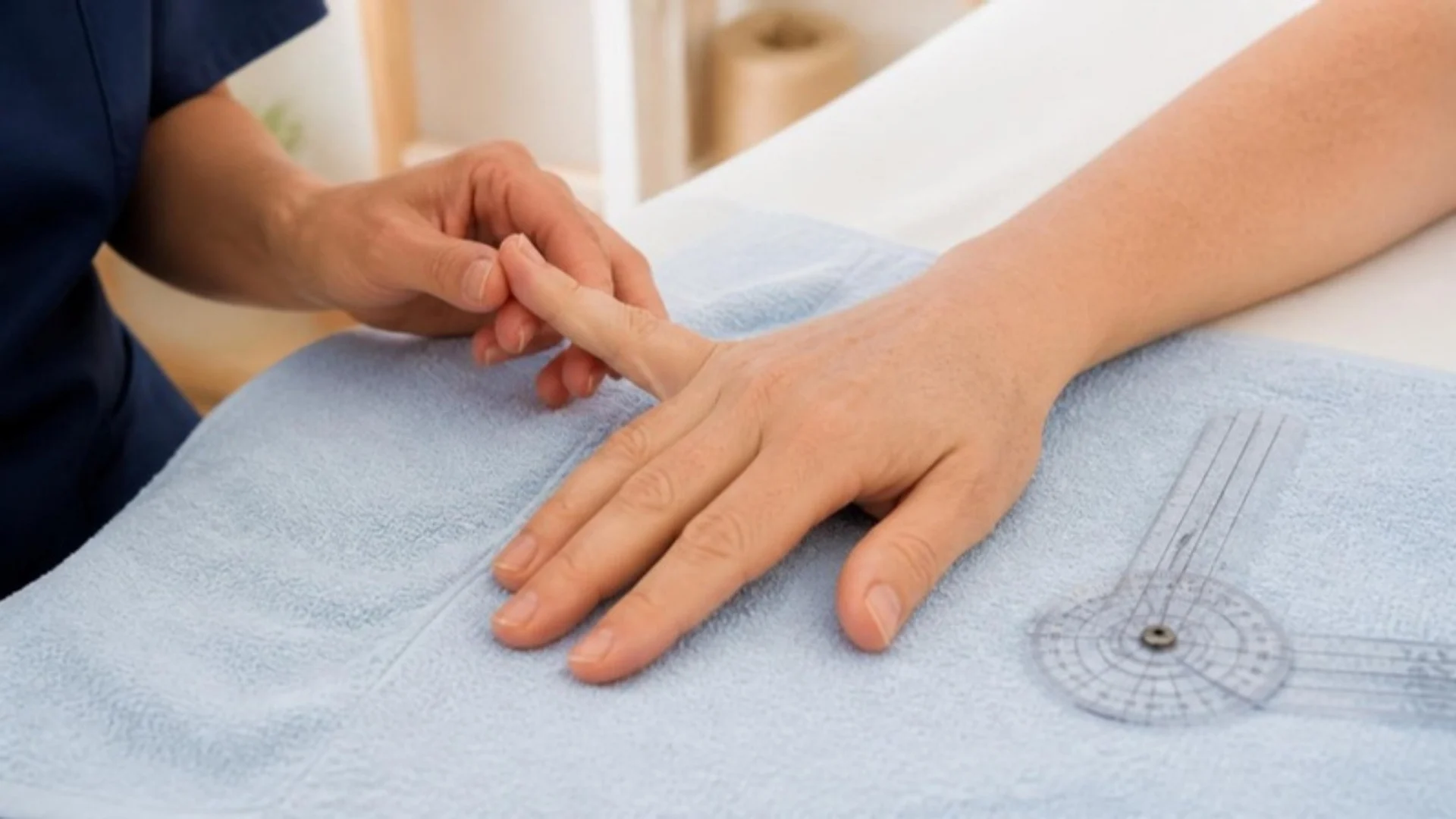
Scoring takes me a few minutes, and most of the evaluation goes into working out what that result means for the person in front of me.
Why Does Hypermobility Make Your Whole Body Hurt?
I usually explain joint stability to patients using their own knee. A joint stays stable in two ways. Ligaments and the joint capsule act as passive restraints, stopping the joint at the end of its range without any effort from you. Muscles add active control on top of that. In a truly hypermobile body, the passive restraints are more lax, so the muscles take over a share of work that ligaments would normally handle.
I want you to picture standing on a moving bus without holding the rail. Your calves, thighs, hips and trunk stay tense for the whole ride because nothing else is keeping you upright. When you get off, you feel tired in places you never consciously used. That is close to what the muscles around a lax joint do all day, at every joint that needs them.
The second step in that chain has been measured. A systematic review and meta-analysis found that people with joint hypermobility syndrome had significantly poorer joint position sense in the lower limb than people without it.[4] When the brain is less certain where a joint sits, one common strategy is to hold it more tightly.
Researchers have recorded that holding pattern as well. Measuring knee muscle activity in girls with generalized joint hypermobility, they found higher co-activation, meaning opposing muscle groups firing together, along with faster early force production and greater muscle activity on the inner side of the knee compared with girls without hypermobility. The authors interpreted the faster force production as a motor adaptation to compensate for the hypermobility.[5]
I see this pattern often in my clinic. When I place my hands on the muscles across the top of the shoulders or along the spine, they are already firm before we have started any exercise. Muscles around the neck, shoulder blades, low back and hips stay switched on for hours because they are guarding joints that do not hold themselves steady. Muscles that rarely get to relax fatigue, develop trigger points and hurt. Because the guarding happens at many joints at once, the pain does not stay in one place. Patients describe it as everywhere, and that diffuse quality is a big part of why it gets dismissed or labelled as stress.
One patient came to me with chest wall and rib pain they had been living with for a long time. Progress came from looking at what was happening around the painful area, beyond the spot that hurt.
"From my first visit, she took the time to really listen, understand what I was experiencing, and evaluate what was going on rather than simply treating the area where I hurt. Dr. Grace is extremely knowledgeable, thoughtful and thorough, and her hands-on approach has already made a significant difference for me."
Tight muscles in a hypermobile body are often tight for a reason. Many of my patients have stretched for years, felt better for an hour, and then felt the tension creep back because the joint still needed protecting. When we build strength and control at the joint, those muscles have less to guard, and that is when the tension starts to ease for longer stretches of the day.
How Is Hypermobility Linked to Lipedema?
Patients with lipedema often mention, almost as an aside, that they could always do the splits or that their knees bend backward when they stand. Researchers have now started studying that overlap directly, and two studies stand out.
The first study, published in the International Journal of Obesity, concluded that hypermobility may be a comorbid condition in lipedema.[6] In the second, published in the Journal of Clinical Medicine, people with lipedema described joint pain most often in the ankles, knees, neck, sacrum and feet, and showed significantly more connective tissue related movement problems and body-wide symptoms than a comparison group with lymphedema. Those authors suggested lipedema may involve connective tissue throughout the body, which would change how the condition is understood and treated.[7]
For my patients, this plays out in a very physical way. Lipedema adds tissue and weight to the legs. Hypermobile knees and ankles have less passive restraint to manage that load. The common result is knees that drift inward, feet that roll flat, and hip and thigh muscles working all day to keep the leg aligned. I explain how that cascade reaches the knee in why knees hurt with lipedema.
It also shapes how I prescribe exercise. Hypermobile joints need strength and control. Lipedema tissue needs movement that supports lymphatic flow without triggering inflammatory flares. Getting both right at once is the reason clinically guided exercise for lipedema is dosed so carefully.
"Dr. Grace has been an exceptional partner for my lipedema journey. She is so knowledgeable and caring. She really works magic!"

Slow, controlled strength work through the middle of a joint's range teaches it to hold itself, so the surrounding muscles can stop guarding.
What Actually Helps When You Are Hypermobile?
Research on physical therapy for hypermobility is still developing. A 2021 systematic review of six randomized controlled trials in hEDS found that pain and proprioception improved in the intervention groups regardless of the specific approach, while noting that larger, more rigorous trials are still needed.[8] A second systematic review of conservative care for symptomatic hypermobility found that patients improved across a wide range of outcomes over time, though no single program has yet proven better than the others.[9] In my clinic, I build each program around the mechanism I described above and adjust it to the person.
Strength work starts in the middle of each joint's range, where control is easiest to learn, and moves toward the ends of range gradually. Balance and slow, deliberate movement with feedback retrain the sense of joint position, so the muscles do not have to guess. Hands-on treatment, including trigger point release and dry needling where appropriate, helps overworked muscles settle while the new stability takes over their job. Pacing matters too, since hypermobile tissue usually tolerates repeated small loads better than one big effort. My movement and mobility work is built around exactly this kind of progression.
Kea described what that kind of session feels like from the patient side: careful, personal, and still challenging.
"She made the session feel very personalized rather than rushed or generic, constantly checking in to make sure I was comfortable while still challenging me in a safe and effective way. I noticed real pain relief. I'm moving more comfortably now and so grateful for her help."
Jeff came to me with chronic shoulder pain while practicing hot yoga four to five times a week. We kept him on the mat and improved his practice one activity at a time.
"She worked with me to isolate all activities I was doing to create my injury and one by one together we improved them. I am grateful to know that I have a partner in my corner who can help me stay active, so I can live a healthy life and feel good while continuing to push the limit physically."
Should You Ask for a Hypermobility Screen?
If you have lipedema and recognize yourself here, with loose joints since childhood and widespread pain as an adult, ask for a hypermobility screen at your next assessment. Mention the joints the Beighton test skips, such as a shoulder that has slipped or ankles that roll, and tell your therapist what you could do as a teenager, because that history can count toward the result.
The tension you carry in your neck, shoulders and hips has a mechanical reason behind it: muscles doing a job your ligaments cannot fully do. As your joints gain strength and control, those muscles can ease off, and pain that seemed to live everywhere starts to settle into something you can manage. Knowing about the hypermobility also changes which exercises make sense for you, how compression and lymphatic care fit in, and what kind of progress to expect.
My lipedema and lymphedema therapy sessions take place at my Leesburg clinic, where I see patients from across Loudoun County and Northern Virginia, and you can reach out here to start that conversation. If you are still comparing providers, this page explains what to look for in a certified lymphedema therapist and why the combination of credentials matters for cases like this.
Joint Hypermobility in the Lipedema Patient: Screening, Mechanism and Rehabilitation
This section is written for the physician, physical therapist or lymphedema therapist evaluating patients with lipedema who also report widespread musculoskeletal pain. Hypermobility is frequently present in this population and often unscreened, and its presence changes both the interpretation of pain and the design of the exercise program.
Classification and Screening
The 2017 framework from the International Consortium on the Ehlers-Danlos Syndromes replaced joint hypermobility syndrome with a spectrum running from asymptomatic generalized joint hypermobility (GJH), through the hypermobility spectrum disorders (generalized, peripheral, localized and historical HSD), to hypermobile EDS.[2] Generalized joint hypermobility is defined by age-adjusted Beighton cutoffs of 6 or more before puberty, 5 or more from puberty to age 50, and 4 or more after 50, with the five-point questionnaire supporting the finding when the score falls one point short.[3] A diagnosis of hEDS additionally requires two of three criteria covering systemic features of a connective tissue disorder, positive family history, and musculoskeletal complications, along with exclusion of alternative diagnoses including other heritable and acquired connective tissue disorders.[3] Features suggesting vascular EDS, Marfan syndrome or Loeys-Dietz syndrome warrant genetics referral before progressive loading is prescribed.
Two practical caveats apply in lipedema. The Beighton score samples a limited set of joints and does not capture shoulder, hip, temporomandibular, ankle or foot hypermobility. In addition, subcutaneous tissue volume around the knee and elbow can complicate visual estimation of hyperextension, so goniometric measurement and the historical questionnaire carry more weight in this population.
Neuromuscular Mechanism of Widespread Pain
A systematic review and meta-analysis by Smith and colleagues found significantly poorer lower limb joint position sense in people with benign joint hypermobility syndrome compared with controls.[4] EMG work by Jensen and colleagues in girls with GJH demonstrated higher flexion-extension and medial-lateral co-activation ratios, reduced hamstring agonist drive, higher medial muscle activation consistent with greater medial knee compression, and a 53% faster early rate of torque development, which the authors interpreted as a motor adaptation to compensate for hypermobility.[5] Taken together, reduced passive restraint and degraded proprioceptive input favor a stiffening strategy based on sustained co-contraction. Across multiple joints, that strategy plausibly accounts for the diffuse myofascial pain, fatigue and trigger point burden these patients present with. Pain in this population is multifactorial, and the guarding pattern is one component the clinician can directly treat.
The Lipedema Overlap
Beltran and Herbst reported hypermobility by Beighton score in 58% of a 160-patient lipedema group compared with 23% of a Dercum's disease group (P<0.0001), and proposed hypermobility as a possible comorbid condition in lipedema.[6] Fiengo and Sbarbati found that 44% of lipedema respondents reported current joint hypermobility and 60% reported childhood hypermobility, with joint pain concentrated in the ankles, knees, cervical spine, sacrum and feet, and significantly more connective tissue related motor deficits and systemic symptoms than lymphedema controls.[7] Their survey design relies on self-report, so these figures describe association rather than confirmed GJH prevalence. No systematic review has yet pooled this question, so both primary studies are cited here as the best available evidence. Clinically, the combination of lower limb tissue load and reduced passive joint restraint is consistent with the valgus knee alignment and foot overpronation frequently observed in lipedema, and it raises the importance of addressing joint control alongside complete decongestive therapy.
Rehabilitation Implications
Reychler and colleagues' 2021 systematic review of six RCTs in hEDS found improvements in pain or proprioception in intervention groups across heterogeneous approaches, while noting that well-designed trials are still lacking.[8] Palmer and colleagues' systematic review of conservative interventions for syndromic hypermobility similarly reported improvement over time across all included studies, with only weak evidence that any specific intervention outperforms its comparator.[9] In the absence of a single validated protocol, the mechanism supports mid-range strengthening progressing toward end-range control, proprioceptive and balance retraining, graded and paced loading, and caution with sustained end-range stretching that may reinforce laxity. Manual therapy and dry needling can reduce guarding while stability is built. For lipedema patients, this program has to be dosed alongside the inflammatory and lymphatic considerations described in our exercise dosing framework.
For co-managing providers in Loudoun County and Northern Virginia, I am available for consultation on patients presenting with lipedema, widespread pain and suspected hypermobility. The dual DPT and CLT credential allows the musculoskeletal and lymphatic components to be assessed and treated in a single clinical relationship.
References
- Blajwajs L, Williams J, Timmons W, Sproule J. Hypermobility prevalence, measurements, and outcomes in childhood, adolescence, and emerging adulthood: a systematic review. Rheumatol Int. 2023;43(8):1423–1444. doi:10.1007/s00296-023-05338-x
- Castori M, Tinkle B, Levy H, Grahame R, Malfait F, Hakim A. A framework for the classification of joint hypermobility and related conditions. Am J Med Genet C Semin Med Genet. 2017;175(1):148–157. doi:10.1002/ajmg.c.31539
- Malfait F, Francomano C, Byers P, et al. The 2017 international classification of the Ehlers-Danlos syndromes. Am J Med Genet C Semin Med Genet. 2017;175(1):8–26. doi:10.1002/ajmg.c.31552
- Smith TO, Jerman E, Easton V, et al. Do people with benign joint hypermobility syndrome (BJHS) have reduced joint proprioception? A systematic review and meta-analysis. Rheumatol Int. 2013;33(11):2709–2716. UEA repository record
- Jensen BR, Sandfeld J, Melcher PS, Johansen KL, Hendriksen P, Juul-Kristensen B. Alterations in neuromuscular function in girls with generalized joint hypermobility. BMC Musculoskelet Disord. 2016;17:410. PMC5048689
- Beltran K, Herbst KL. Differentiating lipedema and Dercum's disease. Int J Obes (Lond). 2017;41(2):240–245. doi:10.1038/ijo.2016.205
- Fiengo E, Sbarbati A. Lipedema and Hypermobility Spectrum Disorders Sharing Pathophysiology: A Cross-Sectional Observational Study. J Clin Med. 2025;14(20):7195. doi:10.3390/jcm14207195
- Reychler G, De Backer MM, Piraux E, Poncin W, Caty G. Physical therapy treatment of hypermobile Ehlers-Danlos syndrome: A systematic review. Am J Med Genet A. 2021;185(10):2986–2994. doi:10.1002/ajmg.a.62393
- Palmer S, Davey I, Oliver L, Preece A, Sowerby L, House S. The effectiveness of conservative interventions for the management of syndromic hypermobility: a systematic literature review. Clin Rheumatol. 2021;40(3):1113–1129. doi:10.1007/s10067-020-05284-0
