

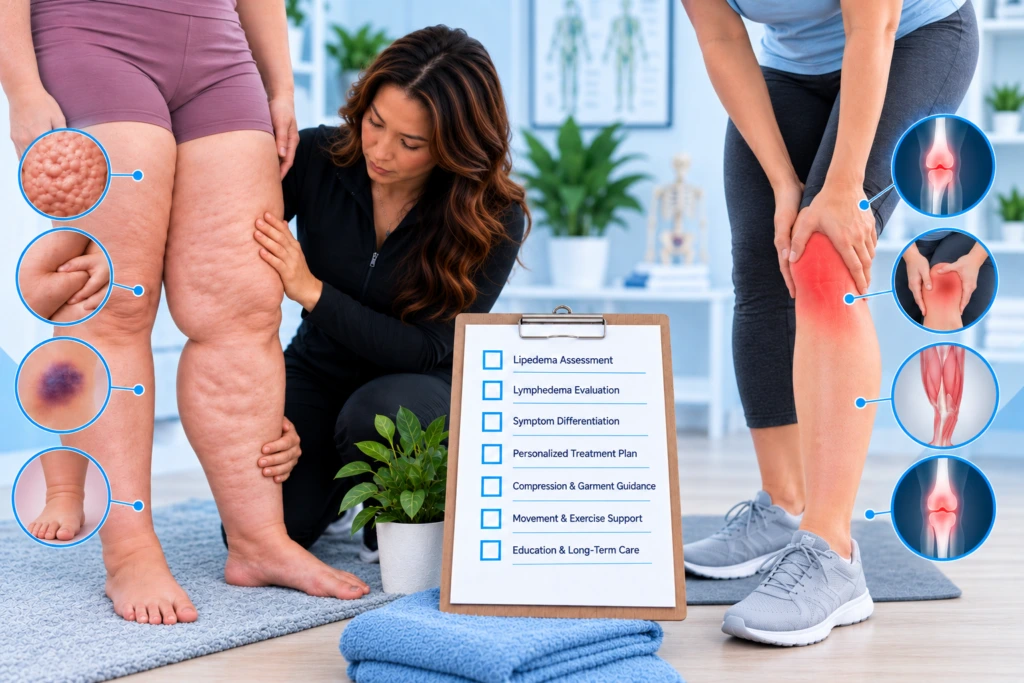
Most of my lipedema patients spent years before their diagnosis describing their leg pain to doctors and being told it was normal. Normal for their size. Normal for their age. Normal for how much they were on their feet. What they knew, without being able to prove it, was that it did not feel like the leg pain their friends and family described. It felt different, and they were right.
Lipedema pain has a specific clinical character. Going through what distinguishes it from other types of leg pain is useful both for patients still trying to make sense of what they are experiencing and for those already diagnosed who want to understand why their legs behave the way they do.
What Lipedema Pain Actually Feels Like
The pain in lipedema comes from a combination of chronic inflammation, mechanical pressure from enlarged and structurally abnormal adipose tissue pressing on nerves, and altered sensory thresholds in the affected skin.[1] A 2025 systematic review of 61 studies on lipedema confirmed that pain, swelling, and a sensation of heaviness are the defining clinical features, and that the pain has both nociceptive and neuropathic characteristics.[1] That matters because neuropathic pain does not always respond the way musculoskeletal or vascular pain does, which is part of why standard pain management approaches often underperform in this condition.
The pain tends to be spontaneous, meaning it is present even when you are not doing anything that would normally cause discomfort. It also responds disproportionately to touch. Light pressure, the waistband of a pair of trousers, a hand resting on the thigh, a firm seat pressing against the back of the legs, produces pain that most people would not expect from that level of contact. Researchers measuring pressure pain thresholds in lipedema patients found a roughly twofold reduction compared to BMI-matched controls without the condition.[2] The legs are genuinely more sensitive to pressure at a measurable, physiological level.
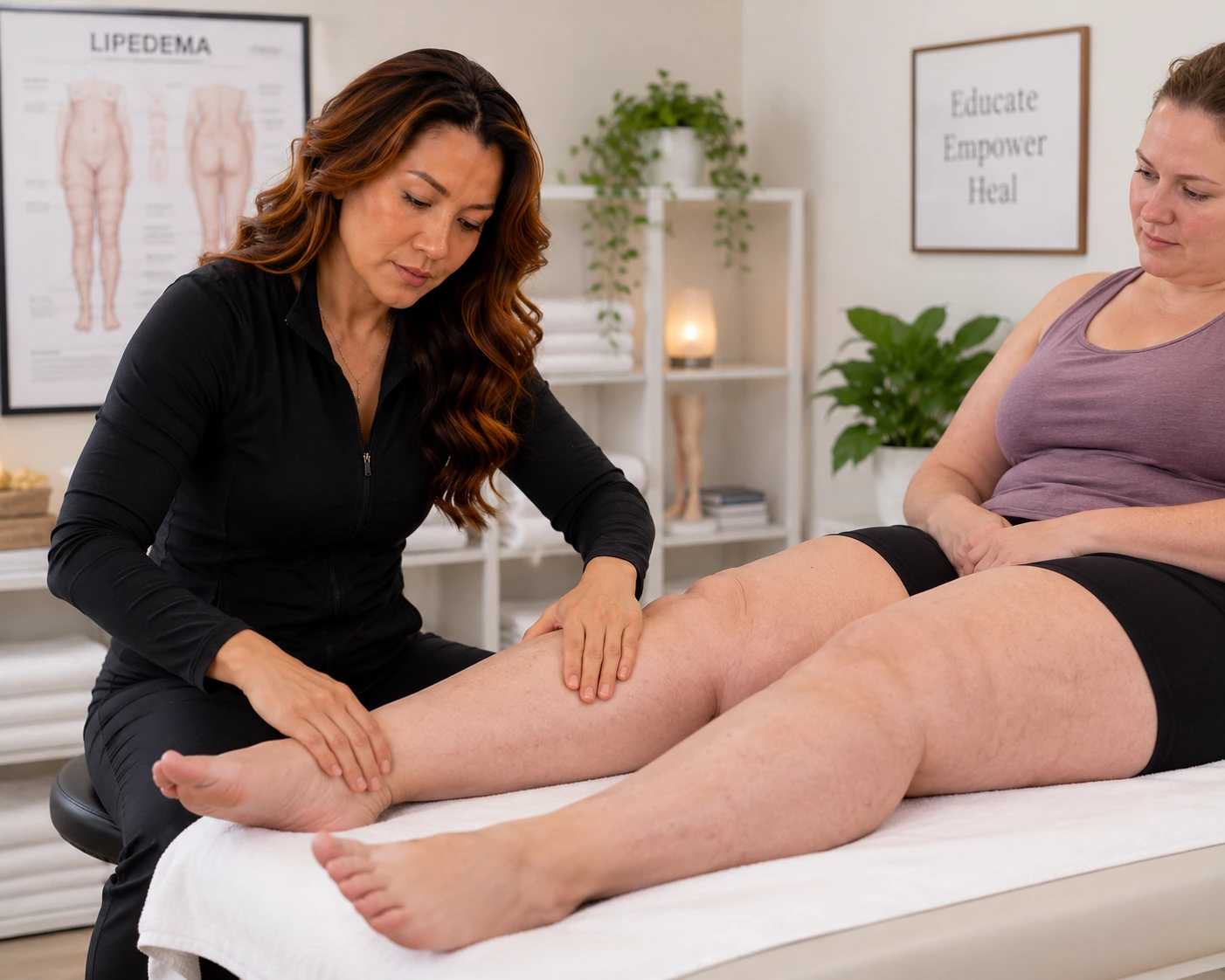
Lipedema pain has a specific clinical character that a trained assessor can identify. The tissue feels different under examination, not just in patient self-report.
Working Through the Checklist
Are both legs affected the same way?
Lipedema fat accumulation is bilateral and symmetrical. Both legs enlarge together, at a similar rate, in the same distribution. If your left leg is significantly more swollen or painful than your right, that asymmetry points toward something else: venous disease, lymphedema from a unilateral cause, or a DVT. Bilateral pain that affects both sides equally, particularly from the hips down, is one of the consistent features clinicians look for.[3]
Are your hands and feet spared?
The abnormal fat accumulation in lipedema stops at the ankles and wrists. Hands and feet remain relatively unaffected, creating what is sometimes called the cuff sign: a clear demarcation between the enlarged leg and the normal-appearing foot. In lymphedema, the foot and toes typically swell as well. In lipedema, the foot is spared. If you can clearly see that ankle line where the swelling stops, that is clinically meaningful.[3]
Does putting your legs up help?
In venous insufficiency, elevating the legs reduces swelling and discomfort, often quite quickly. In lipedema, elevation does not produce that same relief. The heaviness and pain persist regardless of position because the problem is structural fat tissue, not primarily fluid accumulation responding to gravity.[4] Patients often describe trying to sleep with their legs elevated and finding it made no meaningful difference. That is a useful clinical clue.
Did diet or exercise change the shape of your lower body?
Standard weight loss approaches, including calorie restriction, low-carbohydrate diets, and bariatric surgery, do not resolve lipedema fat. A 2025 review in Obesity Reviews cited case series showing persistent lipedema pain in patients after bariatric surgery, while their general weight decreased.[2] Patients often report that their upper body changes with sustained dietary effort, but their hips and legs stay disproportionate. Diet has a meaningful role in managing lipedema, particularly in reducing inflammation, but it does not resolve the fat distribution itself.
Does it get worse through the day and in heat?
Lipedema swelling and discomfort are typically worse in the afternoon and evening, after prolonged standing or sitting, and in warm weather. Heat causes vasodilation, which increases fluid filtration into tissue that is already congested. This worsening with heat and orthostatic loading differentiates it from musculoskeletal leg pain, which typically worsens with specific movements rather than environmental conditions.[1] If your legs feel heavier and more painful on a hot day than a cool one, and worse after standing all morning than after a night of sleep, that pattern fits.
Does the skin feel different when you press it?
Lipedema tissue has a granular or nodular texture under pressure, often described as feeling like small peas or rice grains under the skin. The 2025 Obesity Reviews paper on lipedema criteria lists this as one of the clinical examination findings that distinguishes lipedema from other forms of fat accumulation or swelling.[2] Ordinary adipose tissue does not have that quality. Lymphedema tissue can become fibrotic but feels different from the nodularity of lipedema. This is something I assess specifically in every lipedema evaluation, because it gives information that a measurement or scan does not capture.
"After years of feeling like something was wrong with my body, I was finally diagnosed with lipedema, and finding Grace has truly been life-changing. By my second treatment session, I could already see and feel a noticeable difference in my swelling legs, pain, and overall comfort."
Easy bruising is frequently listed as a lipedema symptom, and many patients report it. The mechanism proposed is capillary fragility within the lipedema adipose tissue. However, the 2024 S2k Guideline on lipedema explicitly states that easy bruising is no longer considered a supported diagnostic criterion, as the evidence for increased capillary fragility specific to lipedema is not yet confirmed by histological or imaging studies.[5] Earlier research did find a correlation between lipedema-associated bruising and measurable capillary fragility that improved with complete decongestive physiotherapy, but this remains an area of active discussion in the clinical literature.[6]
If you bruise easily in your lipedema-affected areas, document it and mention it to your provider. It may be relevant. It should not, on its own, be the basis for a diagnosis.
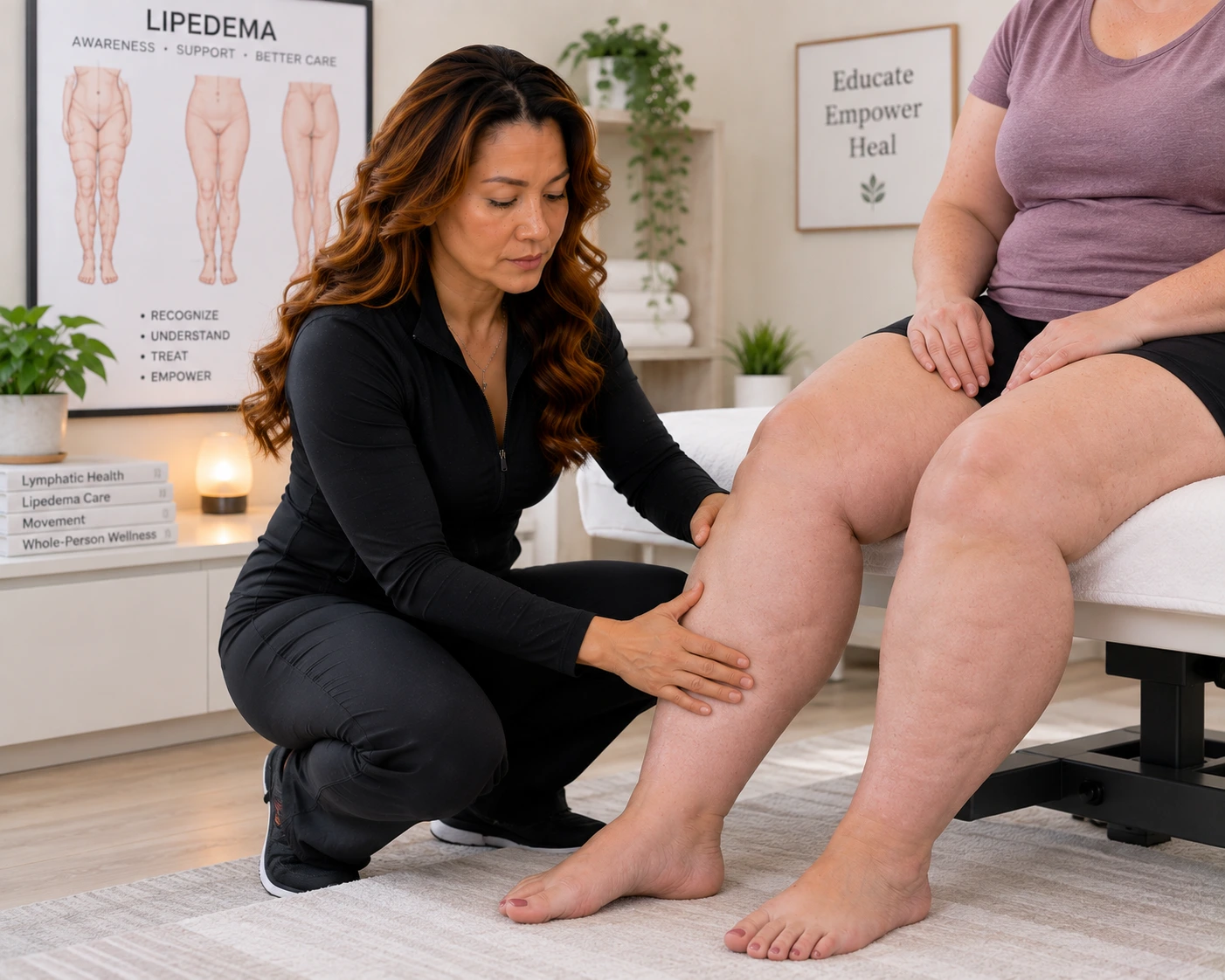
The bilateral symmetry of lipedema, the cuff sign at the ankle, and the tissue texture are all assessed during a clinical evaluation.
What Else Causes Leg Pain, and How to Tell the Difference
Venous insufficiency produces leg heaviness and swelling that genuinely does improve with elevation and worsens with prolonged standing. The skin in venous disease typically develops visible changes over time: discoloration, hemosiderin staining, and sometimes ulceration near the ankle. Lipedema skin does not develop those changes unless venous disease coexists with it. Pain from venous insufficiency tends to be accompanied by visible varicosities or skin changes, and it responds to compression in a way that pure lipedema pain does not fully resolve with.
Lymphedema produces pitting edema, meaning you can press a finger into the skin and leave an indentation that takes time to refill. In lipedema, the tissue typically does not pit, at least in early and middle stages before a lymphatic component develops. The Stemmer sign, which is the inability to pinch a fold of skin at the base of the second toe, is positive in lymphedema and usually negative in lipedema.[3] Lymphedema also typically involves the foot and toes. Understanding what kind of swelling you have is the first step toward treating the right condition.
Musculoskeletal leg pain from joint degeneration, muscular strain, or nerve root compression tends to be specific to particular movements or positions. It worsens with certain activities and eases with others. The spontaneous, diffuse, bilateral, touch-sensitive pain of lipedema does not follow that pattern. Fibromyalgia can produce widespread tenderness, but it does not produce the disproportionate bilateral lower body enlargement that lipedema does. If you have knee pain alongside your lower leg symptoms, that combination has its own specific clinical explanation in lipedema that deserves attention.
The inflammatory component of lipedema pain is one reason that managing it requires more than standard pain management. The tissue itself is in a state of chronic low-grade inflammation, driven by macrophage infiltration and microvascular dysfunction. Treating the pain without addressing the inflammatory environment in the tissue means treating a symptom while the underlying condition continues to progress.
"She was the first to truly listen with compassion. She helped relieve my discomfort from inflammation and swelling, and I felt better almost immediately. She honestly helped give me my life back."
If you have worked through this checklist and recognise several of these features in your own experience, the next step is a clinical assessment with someone who is trained to identify lipedema. Most general practitioners do not receive lipedema training, and the condition is frequently misdiagnosed as obesity or venous disease. A certified lymphedema therapist with the dual DPT and CLT credential is equipped to assess the tissue, evaluate the distribution and quality of the fat, and distinguish lipedema from the conditions it is commonly confused with. Reach out here if you are based in Loudoun County or Northern Virginia and want to start that conversation.
Differential Diagnosis of Lipedema Pain: Clinical Assessment Framework
This section is written for the physician, nurse practitioner, or physical therapist conducting an initial or confirmatory assessment of a patient presenting with bilateral lower extremity pain and disproportionate fat distribution. The clinical differential for this presentation is broad, and lipedema is frequently missed at the primary care level due to limited familiarity with its specific examination findings.
The Clinical Criteria
A 2025 systematic review of 61 studies on lipedema diagnosis and clinical manifestations confirmed five primary diagnostic criteria: bilateral disproportionate fat deposition in the lower extremities with sparing of the hands and feet; granular or nodular texture on palpation of the affected areas; pressure sensitivity with persistent pain and tenderness; capillary fragility with bruising at minimal trauma (though this criterion is contested in the 2024 S2k Guideline, as discussed below); and absence of pitting edema in pure lipedema without concurrent lymphatic involvement.[1] The Cleveland Clinic Journal of Medicine differential diagnosis framework adds symmetrical tissue enlargement, painful palpable nodules, hypothermia of the skin, telangiectasias, and a negative Stemmer sign as examination findings that point toward lipedema over lymphedema or venous disease.[3]
The pressure pain threshold data from a 2025 Obesity Reviews paper citing Dinnendahl et al. is worth integrating into clinical assessment. Using the protocol of the German Research Network on Neuropathic Pain, the study found that pressure pain thresholds at the quadriceps femoris and thenar eminence were reduced approximately twofold in lipedema patients compared to BMI-matched controls, with z-scores aligning with the reported tenderness in the clinical literature.[2] This sensory alteration was independent of depression, anxiety, or stress, which were all within normal ranges on the DASS questionnaire. The pain in lipedema therefore has both a mechanical component from adipose tissue pressure on peripheral nerves and a somatosensory component that reflects altered central processing, not purely a volitional or psychological response.
Key Differentiators from Common Misdiagnoses
The three conditions most frequently confused with lipedema at the primary care level are chronic venous insufficiency, lymphedema, and obesity. Venous insufficiency produces limb swelling and heaviness that reliably improves with elevation, is associated with skin discoloration, hyperpigmentation, and ulceration in more advanced stages, and typically involves visible varicosities or duplex-confirmed venous reflux.[4] Lipedema pain does not improve with elevation, the skin does not develop hemosiderin staining, and venous studies are typically normal unless venous disease coexists, which it can. The coexistence of lipedema and venous insufficiency does not eliminate lipedema as a separate entity requiring its own management.
Lymphedema is distinguished by the Stemmer sign, pitting edema especially in the digits, involvement of the foot and toes, and history consistent with a lymphatic insult (cancer treatment, infection, or congenital). Lipedema spares the foot, produces a negative Stemmer sign in uncomplicated cases, and does not pit in early to middle stages. When lipedema progresses to include lymphatic compromise, the clinical picture becomes lipolymphedema, which requires addressing both the adipose and lymphatic components simultaneously. The diagnostic distinction matters because the treatment priority shifts.
Differentiating lipedema from obesity relies on the distribution pattern, tissue quality, and pain response. Obesity-related fat accumulation is generalized, responds to caloric restriction, and is not intrinsically painful. Lipedema fat is regionally specific to the lower extremities, persists despite weight loss, and is associated with spontaneous pain and pressure tenderness that simple obesity does not produce. The coexistence of lipedema and obesity is common and complicates the clinical picture, but the lipedema component can be identified by the disproportionate lower body enlargement, the sparing of the feet, the nodularity on palpation, and the pain response to light pressure.[2]
A Note on Easy Bruising in the Diagnostic Picture
Easy bruising has historically been included in lipedema diagnostic criteria and is reported by many patients. The proposed mechanism is capillary fragility within the lipedema adipose tissue, driven by microvascular dysfunction and structural changes in the interstitium. One study demonstrated a correlation between lipedema-associated bruising and measurable capillary fragility that improved significantly with complete decongestive physiotherapy, suggesting a real physiological mechanism.[6] However, the 2024 S2k Guideline on lipedema removed easy bruising from its diagnostic criteria, citing insufficient histological or imaging evidence for increased capillary fragility as a disease-specific finding.[5] The presence of easy bruising in a patient with other lipedema features should be documented but should not drive diagnosis independently, nor should its absence exclude the diagnosis.
For patients presenting with suspected lipedema who also have knee pain or altered gait, the biomechanical cascade that develops from bilateral lower extremity enlargement deserves specific assessment. The medial knee fat pads, altered valgus loading, and progressive joint stress that accompany advanced lipedema produce a pain pattern that compounds the primary lipedema symptoms and requires targeted intervention alongside lymphatic management. The full assessment should include gait observation, functional movement screening, and evaluation for joint hypermobility, which frequently coexists with lipedema.[3]
If you are co-managing a patient in Loudoun County or Northern Virginia whose leg pain picture is unclear and you want to discuss the clinical assessment, I am available for consultation. The dual DPT and CLT credential is specifically relevant here because the assessment requires evaluating both the musculoskeletal and lymphatic dimensions simultaneously rather than referring to two separate providers. The approach I use for lipedema and lymphedema assessment integrates both into a single evaluation.
Recognition Is Where Treatment Starts
The years most of my lipedema patients spent before their diagnosis were not medically neutral. During that time, the condition progressed, the tissue changed, and many of them absorbed the message that their pain was their own fault. Understanding that lipedema pain has a distinct clinical character, one that differs specifically and measurably from normal leg discomfort, venous pain, or obesity-related symptoms, is the foundation of actually treating the right thing.
If you recognise your experience in this checklist and have not yet had a clinical assessment, that is the next step. Not another diet, not another pair of compression socks bought online, but a proper evaluation of what the tissue is actually doing and why.
References
- Bhatt N, et al. Lipedema Diagnosis, Clinical Manifestations, and Therapeutics: A Systematic Review. PubMed. 2025. PMID 41498193
- Cifarelli V, et al. Lipedema: Progress, Challenges, and the Road Ahead. Obesity Reviews. 2025;26(6):e13953. PMC12404891
- Hettrick H, Aviles F. Lymphedema vs lipedema: Similar but different. Cleve Clin J Med. 2024;91(7):425–434. doi:10.3949/ccjm.91a.23073
- Kumar S, et al. Lipedema: pathophysiological insights and therapeutic strategies. An Bras Dermatol. 2026. doi:10.1016/j.abd.2025.01.008
- Bertsch T, et al. S2k Guideline on Lipedema. German Society of Phlebology and Lymphology. 2024. Referenced in: Lipedema World Alliance Delphi Consensus. Nat Commun. 2025. doi:10.1038/s41467-025-68232-z
- Forner-Cordero I, et al. Measurement of capillary fragility: a useful tool to differentiate lipedema from obesity? PubMed. 2018. PMID 30248725
