

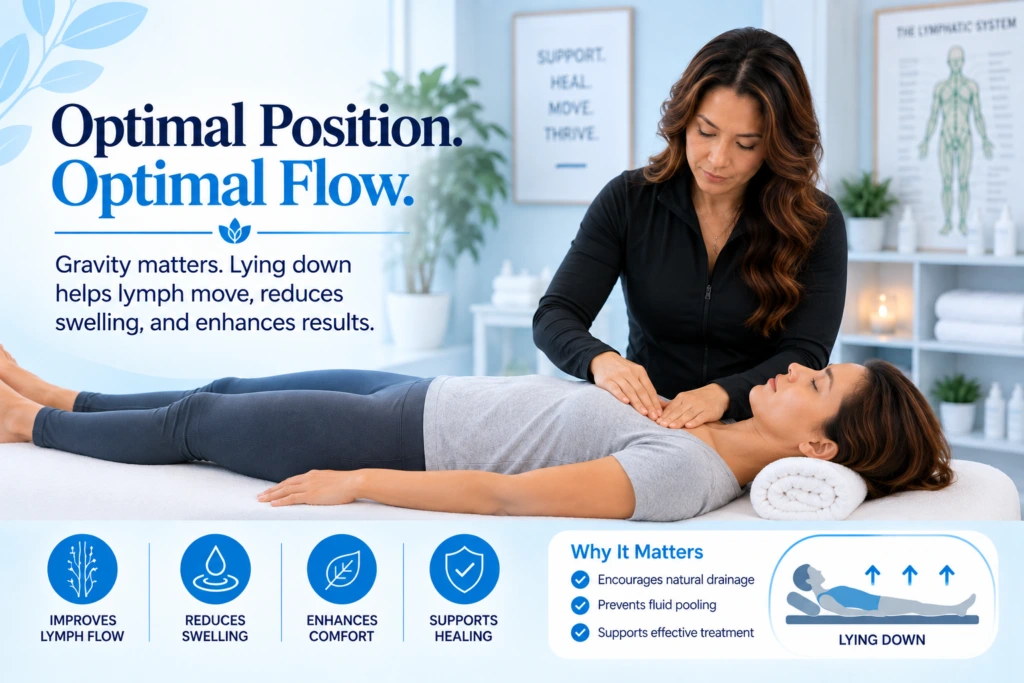
Patients ask me this more than you might expect, usually when I am teaching them self-MLD to do at home between sessions. Can they do it sitting up? Does lying flat actually matter, or is it just more comfortable?
It matters. When you are upright, the venous system your lymphatic fluid is trying to drain into is under 80 to 100 mmHg of pressure at ankle level. When you lie flat, that same venous pressure drops to roughly 8 mmHg. Your lymphatic system is draining into that destination either way. The position determines what it is draining against.
What Happens to Lymphatic Fluid When You Stand Up
When you are upright, gravity is pulling fluid down into your lower extremities continuously. Your venous system manages this through a combination of muscle pump action, venous valves, and pressure gradients between the periphery and the heart. Your lymphatic system faces the same gravitational challenge and has fewer mechanical backup systems to compensate for it.
A 2026 peer-reviewed paper on hemodynamic pressure dynamics at lymphovenous anastomosis sites quantified this precisely. In the supine position, lymphatic pressure at the ankle sits at approximately 12 mmHg and venous pressure sits at approximately 8 mmHg, creating a positive gradient of +4 mmHg that allows lymph to flow toward venous circulation naturally. When you stand up, venous hydrostatic pressure at the ankle rises to approximately 90 mmHg due to the roughly 120 cm column of fluid between your foot and your heart. Lymphatic pressure rises too, but not enough to keep up, reaching approximately 55 mmHg. The gradient reverses to -35 mmHg, actively opposing the drainage you are trying to create.[1]
That 39 mmHg swing is the clinical reason every MLD protocol positions the patient lying flat. It means that performing MLD while sitting upright or standing requires your lymphatic system to push fluid uphill against a pressure gradient that is working in the opposite direction. Lying flat removes that gradient almost entirely, because the horizontal plane distributes hydrostatic pressure evenly across the thorax, abdomen, and legs simultaneously.[2]
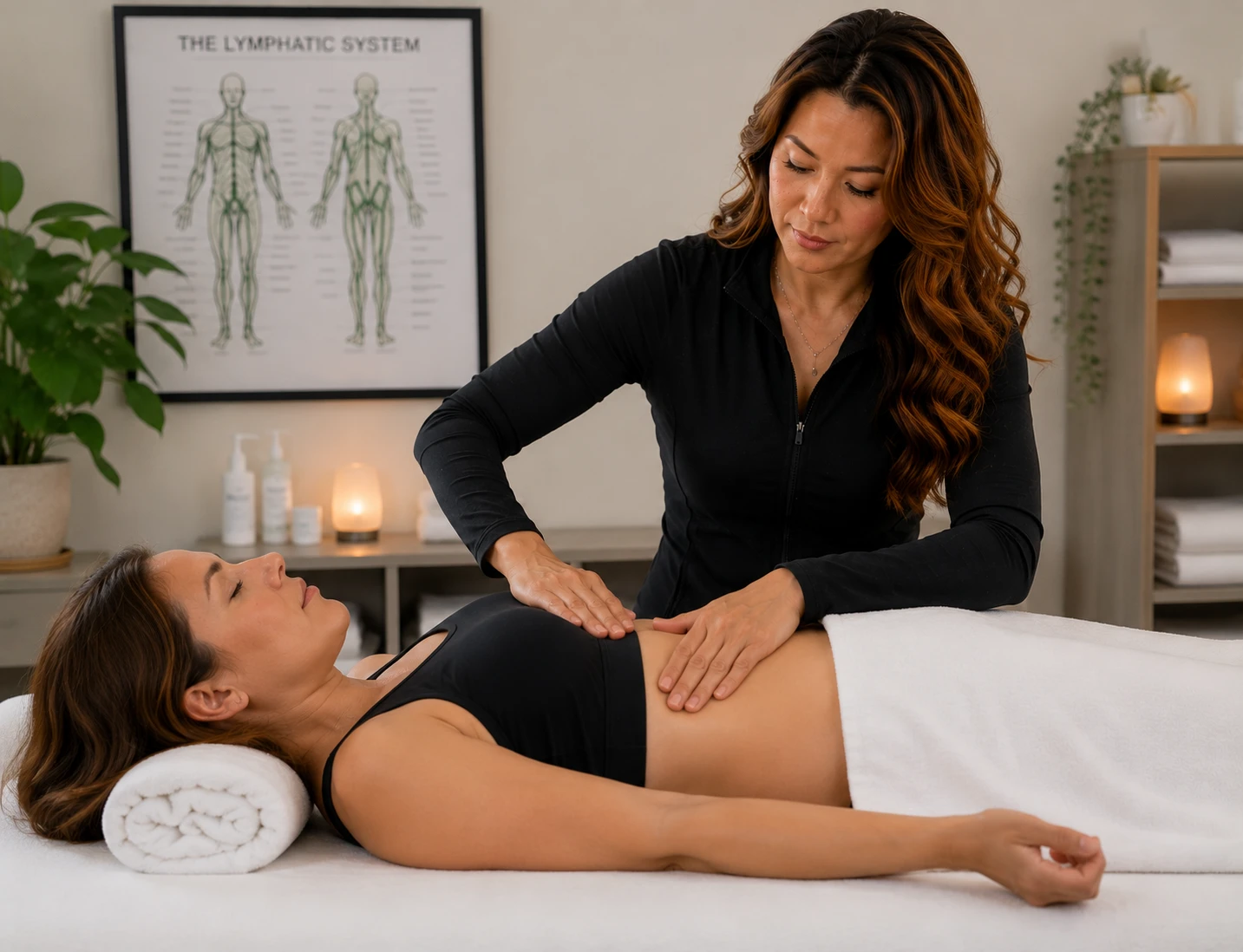
Supine positioning is not a comfort preference. It changes the pressure gradient that lymphatic fluid is working against.
What Supine Actually Does to the Fluid
Research on interstitial fluid pressure in lymphedema has measured this directly. A study cited in a 2022 Scientific Reports paper found that patients with primary lymphedema in one leg had subcutaneous interstitial fluid pressure of 14.8 mmHg when lying supine and 17.9 mmHg when standing, while the healthy leg showed no meaningful change with position.[3] That 3.1 mmHg increase from supine to standing in an already-compromised lymphatic system represents additional resistance to clearance, on top of the underlying pathology that brought the patient in for treatment.
When you lie down, the heart no longer has to overcome the hydrostatic column from the lower extremities. Venous pressure in the legs drops significantly, which reduces the back-pressure that lymphatic vessels have to overcome when returning fluid to venous circulation. Near-infrared fluorescence lymphatic imaging studies consistently position patients supine during MLD assessment and treatment, because this is when lymphatic contractility and flow dynamics are most measurable and most favorable.[4] The effect is visible in real time: lymphatic pulsing patterns and fluid movement toward nodal basins improve with the patient lying flat compared to seated or upright.
When you stand or sit upright, the venous pressure at your ankle is roughly 80 to 100 mmHg. When you lie flat, that same pressure drops to approximately 8 mmHg. Your lymphatic system drains into venous circulation. The lower the venous pressure at the destination, the easier it is for lymph to get there.
What This Means for Self-MLD at Home
I teach every patient who is ready for it to perform self-MLD as part of their Phase II maintenance between our sessions. The first thing I establish before we work on technique is position. Bed or floor, lying flat, ideally with a pillow under the knees if the lower back needs support. Not the sofa in a reclined position, not sitting up against a headboard. Flat means the thorax and the legs are in the same horizontal plane, which is what removes the hydrostatic gradient.
Reema described the shift that happened once she had both the clinical sessions and the at-home practice working together. The consistency of position mattered as much as the consistency of the technique, because without the right position, the technique is working against the physics of the problem.
"By my second treatment session, I could already see and feel a noticeable difference in my swelling legs, pain, and overall comfort. What I appreciate most is that she doesn't just provide treatment, she takes the time to educate you about lipedema and teaches you techniques you can do at home to support your progress between sessions."
The sequence for self-MLD at home follows the same logic as clinical MLD: begin at the central nodes, work proximally before moving distally, and keep the body flat throughout. Opening the terminus at the base of the neck and the axillary or inguinal nodes before working the limb has a specific mechanical purpose: It clears the destination before sending more fluid toward it. If you start at the foot and work upward without clearing the pathway first, you are moving fluid toward a blocked drain. Get one wrong and the other underdelivers.
The same logic applies to home compression pumps. A pump running while you sit upright is pushing fluid toward a venous system at 80 to 100 mmHg of back-pressure at the ankle. The same pump, same settings, same duration, run while you lie flat, is pushing toward roughly 8 mmHg. Lying down does not make the pump stronger. It changes what the pump is pushing against.
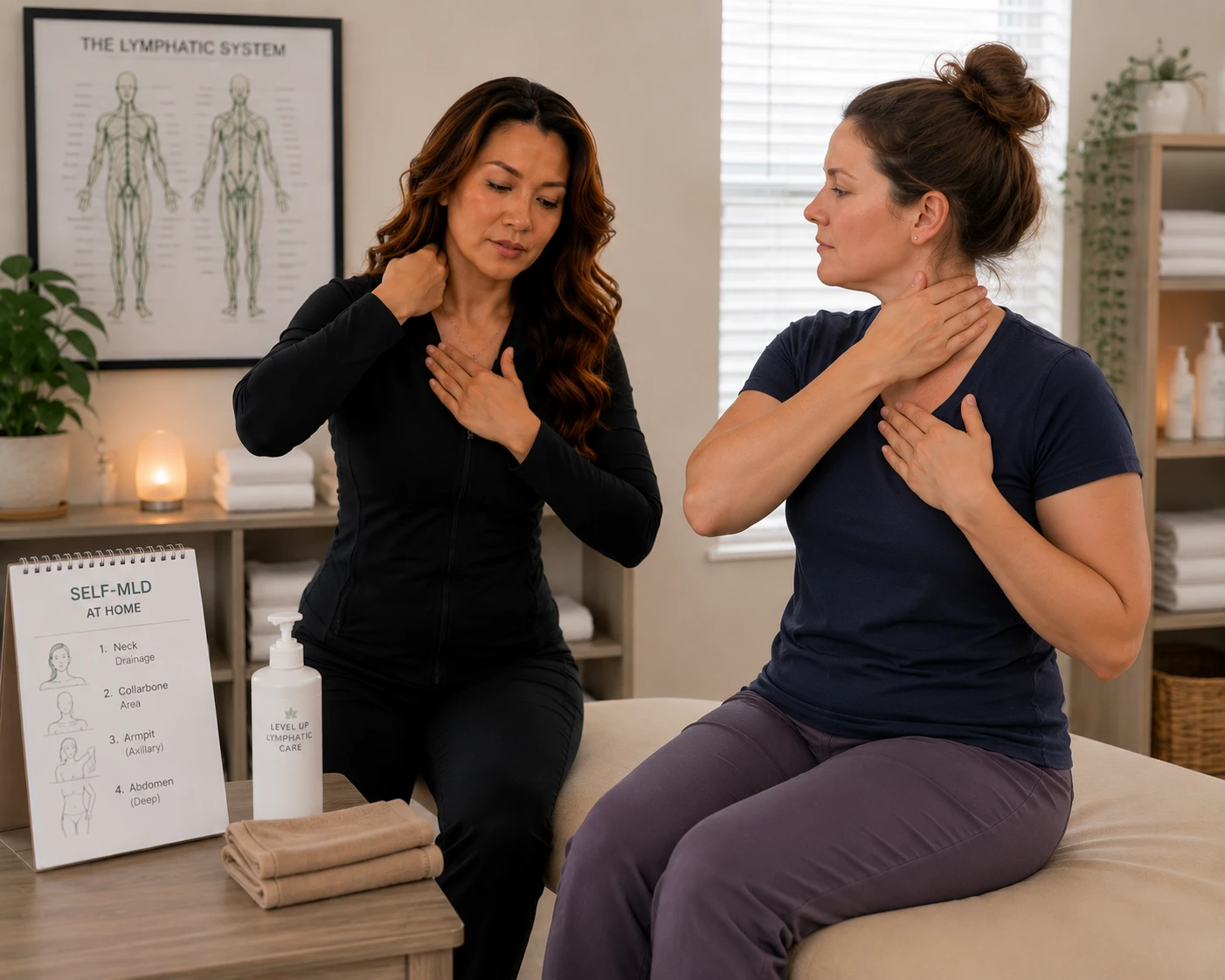
Teaching self-MLD starts with position. Technique performed in the wrong position is working against the physiology it is meant to assist.
When Elevated Positioning Is Used and Why
Leg elevation is sometimes recommended for edema management, and patients ask whether raising the legs above heart level might work even better than lying flat for MLD. They are different things. Elevation uses gravity passively to move pooled fluid back toward the trunk, which can help with general swelling reduction. MLD is an active technique that works along specific lymphatic collector pathways, and it requires access to the full drainage route from the terminus down through the limb. Tilting that route changes how the proximal clearing maneuvers land.
For MLD, flat supine is preferred over elevated because the technique requires access to the full lymphatic pathway from the terminus downward, and some of the proximal clearing maneuvers are easier to perform and more effective when the patient is not angled. There are specific clinical situations, particularly in acute post-surgical swelling or very advanced lymphedema, where modified positioning may be appropriate. That is a clinical judgment made with the full picture in front of us, not a general recommendation to change home practice.
If you want to understand more about why stagnant interstitial fluid creates problems beyond visible swelling, that piece explains the tissue-level consequences that make the positioning question more than just a comfort preference. And if you are still building your home self-management protocol alongside clinical sessions, understanding how CDT phases work helps clarify where self-MLD fits in the larger picture.
"She teaches every step to you so that you can do it on your own and feel independent to take charge of your own care. She explains everything so well, and I better understand my body because of it."
Positional Physiology in MLD: The Pressure Gradient Rationale
This section is written for the physical therapist, lymphedema therapist, or physician who is counseling patients on home self-MLD positioning, or reviewing the physiological rationale for supine positioning in clinical lymphatic treatment protocols. The pressure gradient argument for supine positioning is more quantitatively grounded than most clinical discussions acknowledge, and communicating it clearly to patients improves compliance with home protocols.
Hydrostatic Pressure and Lymphovenous Pressure Dynamics
Lymphatic fluid ultimately re-enters systemic venous circulation at the thoracic duct (left lymphatic trunk) and right lymphatic duct, both emptying into the subclavian-jugular venous junction. The driving force for lymphovenous drainage is a positive pressure gradient from the lymphatic side to the venous side. In the supine position, a 2026 peer-reviewed hemodynamic analysis of lymphovenous anastomosis pressure dynamics measured lymphatic pressure at approximately 12 mmHg and venous pressure at approximately 8 mmHg in the lower extremity, giving lymph a clear path into venous circulation at a net pressure difference of +4 mmHg.[1] In the upright position, venous hydrostatic pressure rises to 80 to 100 mmHg at the ankle due to the vertical column of fluid above it, while lymphatic pressure rises to only approximately 55 mmHg, reversing the gradient to -35 mmHg, meaning venous pressure is actively pushing back against lymphatic return rather than receiving it.[1]
This pressure reversal is the mechanistic basis for supine positioning in MLD. The gravity component is real, but the more precise explanation is the destination pressure at the lymphovenous junction: the lower the venous pressure at that junction, the more favorable the gradient for lymphatic emptying into the venous system. When the patient is supine, venous pressure in the lower extremity approximates central venous pressure rather than hydrostatic column pressure, taking the hydrostatic column out of the equation.
A 2022 Scientific Reports computational and experimental study on interstitial fluid transport in the lower limb confirmed that gravity initiates and perpetuates edema via two mechanisms: increased capillary hydrostatic pressure that drives more filtration into the interstitium, and reduced lymphatic clearance caused by the elevated pressure gradient the lymphatics must overcome.[3] Subcutaneous interstitial fluid pressure in lymphedema patients was measured at 14.8 mmHg supine and 17.9 mmHg standing, a 21% increase from position change alone, independent of any change in activity or fluid intake.[3] In a lymphatic system that is already struggling, a 3.1 mmHg increase from position alone is clinically meaningful.
Near-Infrared Fluorescence Lymphatic Imaging Evidence
Near-infrared fluorescence lymphatic imaging (NIRFLI) studies consistently conduct lymphatic assessment and treatment with patients in the supine position, both for access to the anterior drainage territories and because supine positioning produces the most interpretable lymphatic flow dynamics.[4] A case series using automated MLD therapy with simultaneous NIRFLI in four patients documented that patients rested supine throughout treatment, and that the researchers specifically identified the gravity distribution in the supine position as contributing to the observed changes in pulsatile lymphatic frequency along the back, which decreased in a pattern analogous to reduced resting sympathetic tone.[4] This suggests that supine positioning not only reduces the hydraulic burden on the lymphatics but may also influence intrinsic lymphangion contractility through autonomic pathways associated with parasympathetic activation in the recumbent state.
Clinical Protocol Implications
For home self-MLD instruction, communicate the positioning rationale explicitly. Patients told to lie down without explanation often adapt the instruction to whatever is convenient. Patients who understand that sitting upright places 80 to 100 mmHg of back-pressure at the lymphovenous junction, compared to approximately 8 mmHg supine, tend to maintain the flat position consistently because the reason makes physical sense to them. The self-MLD sequence follows the same proximal-first, terminus-clearing logic as clinical MLD: subclavicular terminus and proximal nodal basins before the distal limb. That sequence is less effective when performed against the unfavorable gradient of upright positioning, because the cleared destination refills faster than it can be maintained.
For patients using home compression pumps alongside self-MLD, the positional rationale applies equally. Pump use in the supine position works against approximately 8 mmHg of venous back-pressure. The same pump in a seated position works against 80 to 100 mmHg at the ankle, with no change in settings, sleeve, or duration. Supine positioning for both modalities, in the correct sequence within the CDT maintenance framework, is the most mechanically sound home protocol available to these patients.
If you are co-managing a patient whose home self-MLD practice or pump protocol needs review, or who would benefit from hands-on self-MLD technique instruction as part of a supervised Phase II transition, I am available for clinical consultation and patient referral in Loudoun County and Northern Virginia.
Position Is Part of the Treatment
Patients sometimes negotiate on this point, usually because finding 20 to 30 minutes to lie flat at home feels like a logistical problem. I understand that. But the position is a clinical decision. Lying flat changes the pressure environment the technique is working inside.
When I teach self-MLD, the position comes first. The technique comes second, because technique applied in the wrong position is technique working against the pressure environment it depends on. Lauren described what changes when lymphatic care is done correctly and consistently at home between sessions. That consistency, done in the right position, is what lets each session build on the one before it rather than starting over.
"Entrusting Dr Grace with my lipedema therapy has been life changing. She doesn't just treat your symptoms but empowers you to continue care at home. She is the best."
If you are ready to learn self-MLD properly, with the correct position, sequence, and technique for your specific drainage territories, my lymphedema and lipedema therapy page covers how I structure that instruction within a supervised CDT plan. And if you are still working out whether you are managing the right condition with the right tools, this page on what to look for in a certified lymphedema therapist is a useful starting point. Reach out here when you are ready to talk through your specific situation.
References
- Nguyen DH, et al. Hemodynamic Challenges of Lower Extremity Lymphovenous Anastomosis: A Critical Reappraisal. J Clin Med. 2026;15(4):1594. doi:10.3390/jcm15041594
- Sjöstrand T. Volume and distribution of blood and their significance in regulating the circulation. Physiol Rev. 1953;33(2):202–228. Cited in: Deranged Physiology — Physiological response to changes in posture. derangedphysiology.com
- Wiig H, et al. The effects of gravity and compression on interstitial fluid transport in the lower limb. Sci Rep. 2022;12:4890. doi:10.1038/s41598-022-09028-9
- Zhu B, et al. Case Report: The effect of automated manual lymphatic drainage therapy on lymphatic contractility in 4 distinct cases. Front Med Technol. 2024;6:1397561. PMC11292613
- Müller M, et al. Manual lymphatic drainage and quality of life in patients with lymphoedema and mixed oedema: a systematic review of randomised controlled trials. Qual Life Res. 2018;27(6):1403–1414. PMC5951867
- Tashiro K, et al. Manual lymphatic drainage for lymphedema in patients after breast cancer surgery: a systematic review and meta-analysis of randomized controlled trials. Medicine (Baltimore). 2020. PMC7717855
